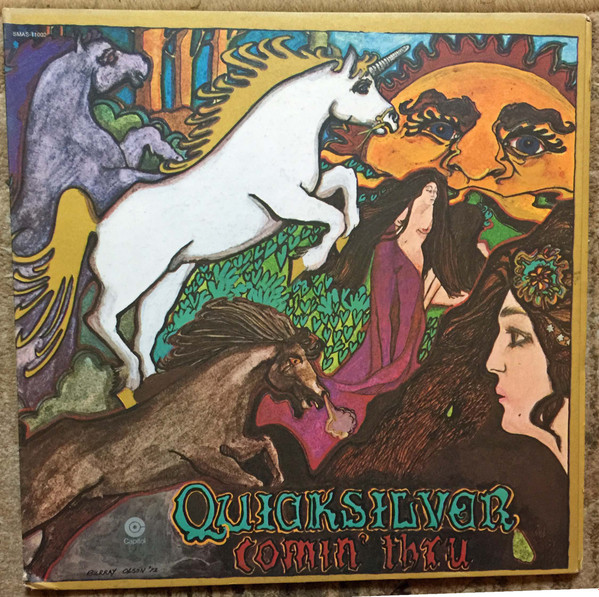
Comin' Thru
 View on Discogs
 View on Wikipedia
Album Summary
Comin' Thru landed on Capitol Records in 1972, and baby, it came at a time when Quicksilver Messenger Service was fighting through some real turbulence — lineup shuffles, a shifting musical landscape, and the long shadow of a San Francisco psychedelic scene that was already becoming a memory. The band had been through the kind of changes that would break a lesser group, with a rotating cast of musicians moving in and out around what remained of the core, and this record captured them in that uncertain moment, reaching for commercial footing on a label that had been home to their later catalog. Produced during a period when the raw, sprawling improvisation that made Quicksilver legends was giving way to tighter, more structured rock arrangements, the album stood as an honest reflection of a band in transition — still swinging, still soulful in stretches, but navigating a world that had moved on from the Haight.
Reception
- The album landed with a muted critical reception, with reviewers of the era broadly viewing it as a step removed from the inspired, free-flowing brilliance of the band's celebrated late-1960s work, noting an absence of the spontaneous energy that had once made Quicksilver essential listening.
- Commercially, Comin' Thru failed to make a meaningful impact on the charts, a result consistent with the declining commercial momentum the band had been experiencing throughout the early 1970s.
- While critics acknowledged moments of solid rock craftsmanship across the record, the consensus positioned the album as the work of a legendary band operating past its creative peak, competent but no longer commanding.
Significance
- Comin' Thru stands as one of the most candid documents of the slow fade of first-generation San Francisco psychedelic rock, capturing Quicksilver Messenger Service at the precise moment when the counterculture's musical vanguard was being absorbed — or left behind — by the mainstream rock machine of the early 1970s.
- The album occupies a meaningful place in the band's arc as one of the final statements of their original run, giving music historians and devoted fans alike a window into how the psychedelic era's great ensembles struggled, adapted, and ultimately wound down in the years following their peak.
- For those who lived and breathed the San Francisco sound, Comin' Thru endures as a bittersweet artifact — proof that even in their twilight, Quicksilver carried the spirit of that remarkable musical moment, however dimmed by circumstance and time.
Tracklist
-
A1 Doin' Time In The USA —
 4:15
4:15
-
A2 Chicken —
4:03
-
A3 Changes —
4:15
-
A4 California State Correctional Facility Blues —
6:10
-
B1 Forty Days —
5:31
-
B2 Mojo —
5:34
-
B3 Don't Lose It —
5:57

Artist Details
Quicksilver Messenger Service was one of the crown jewels of the San Francisco psychedelic rock scene, forming in 1965 right there in the Bay Area alongside fellow travelers like Jefferson Airplane and the Grateful Dead, weaving together blues, folk, and long, exploratory guitar jams that could take a listener on a journey halfway to the cosmos and back. Built around the searing, fluid guitar work of John Cipollina and Gary Duncan, they became a cornerstone of the Haight-Ashbury counterculture movement, with their 1969 album Happy Trails capturing that live, free-flowing spirit better than almost anything else from that era. Though they never quite broke through to the mainstream fame of some of their contemporaries, the true heads always knew that Quicksilver was the real deal — a band that embodied the restless, searching soul of the late sixties like few others could.