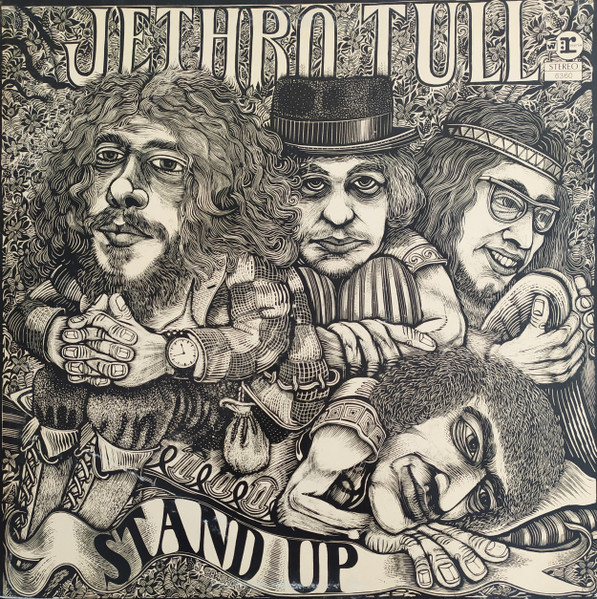
Stand Up
 View on Discogs
 View on Wikipedia
Album Summary
Stand Up came roaring out in the summer of 1969, and baby, it was something else entirely. Released on the Island Records label in the UK and Reprise Records in the United States, this was Jethro Tull's second studio album, and it announced to the whole wide world that these cats were not playing around. Produced by Ian Anderson alongside managers Terry Ellis and Chris Wright, the record was laid down during a time when the British rock scene was shifting and shaking beneath everyone's feet. Ian Anderson had already turned heads with the debut, but Stand Up was where he truly stepped into his own — a young visionary with a flute and a fire in his belly, sculpting something that nobody had quite heard before. It hit shelves in the UK in August of 1969 and in the US not long after, arriving at exactly the right moment in rock and roll history.
Reception
- Stand Up shot straight to number one on the UK Albums Chart, a stunning achievement that confirmed Jethro Tull as one of the most vital and exciting acts to emerge from the British rock scene.
- The album reached number 20 on the Billboard 200 in the United States, proving that the band's singular sound translated powerfully across the Atlantic.
- Critical reception was deeply enthusiastic, with reviewers marveling at the bold folk-rock fusion and the sheer originality of Ian Anderson's flute-driven compositions.
Significance
- Stand Up was a landmark moment in the fusion of folk instrumentation with hard rock and blues, placing the flute front and center as a lead voice in a way that rock music had simply never experienced before.
- The album helped define the emerging progressive rock movement of the late 1960s, demonstrating that rock could carry complex arrangements, acoustic textures, and deep musical traditions without losing an ounce of its raw power.
- Tracks like Bourée — a breathtaking reimagining of a Johann Sebastian Bach composition — signaled that rock musicians could reach into the classical canon and come out swinging, expanding the vocabulary of the entire genre.
Tracklist
-
A1 A New Day Yesterday 184

-
A2 Jeffrey Goes To Leicester Square 146
-
A3 Bourée 115
-
A4 Back To The Family 94
-
A5 Look Into The Sun 81
-
B1 Nothing Is Easy 106
-
B2 Fat Man 131
-
B3 We Used To Know 171
-
B4 Reasons For Waiting 89
-
B5 For A Thousand Mothers 178

Artist Details
Jethro Tull burst onto the scene out of Luton, England back in 1967, led by the wild and wonderfully eccentric Ian Anderson — a man who made the flute as hard-rocking as any electric guitar — blending blues, folk, classical, and heavy rock into something the world had never quite heard before. They were the architects of progressive rock at its most adventurous, dropping landmark records like Aqualung and Thick as a Brick that challenged what an album could even be, earning them a devoted following on both sides of the Atlantic and a permanent place in the rock and roll pantheon. Their legacy is one of fearless originality, proving that serious musicianship and theatrical, literary ambition had every right to live right alongside the raw power of rock.