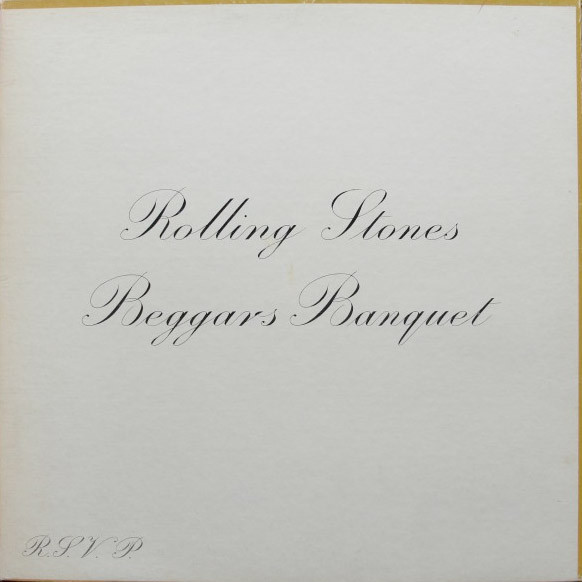
Beggars Banquet
 View on Discogs
 View on Wikipedia
Album Summary
Beggars Banquet was laid down at the legendary Olympic Studios in London across 1967 and 1968, and when Decca Records finally dropped it in December of that year, the music world felt the ground shift beneath its feet. Produced by the masterful Jimmy Miller — a man who understood groove the way a preacher understands scripture — with the full creative firepower of the Rolling Stones themselves, this album was a deliberate and defiant step away from the psychedelic rabbit hole the band had been exploring. The Stones came back to the source, back to the blues, back to something honest and hungry, and what they captured in those sessions was nothing short of a rebirth.
Reception
- Beggars Banquet climbed to number 3 on the UK Albums Chart and number 5 on the US Billboard 200, proving that the Stones' return to their roots resonated deeply with audiences on both sides of the Atlantic.
- Critics received the album as a triumphant reclamation of blues-rock authenticity, celebrating its raw production aesthetic and the band's renewed commitment to stripped-down, soulful arrangements.
- The album stirred genuine controversy upon release, with its edgy lyrical content — particularly on tracks like Sympathy For The Devil and Stray Cat Blues — pushing boundaries and sparking heated debate about rock music's relationship with transgressive subject matter.
Significance
- Beggars Banquet planted a flag for raw, minimalist blues-rock at a moment when the genre had nearly drowned in studio excess, and that flag has never come down — its influence on classic rock, hard rock, and blues-rock runs deep and wide across the decades that followed.
- The album stands as one of the most compelling demonstrations of a rock band fully absorbing the American blues tradition and reshaping it into something unmistakably their own, cementing the Rolling Stones as the definitive blues interpreters for a generation of rock listeners.
- With its unflinching engagement with dark social themes, moral ambiguity, and raw human experience, Beggars Banquet helped forge the template for rock music as a vehicle for serious, provocative artistic expression — a legacy that echoes through every generation of rock that came after it.
Samples
- Sympathy For The Devil — one of the most sampled and interpolated tracks in popular music history, with a rich legacy spanning hip-hop, electronic music, and beyond across multiple decades of production.
Tracklist
-
A1 Sympathy For The Devil 117
 6:14
6:14
-
A2 No Expectations 92
3:52
-
A3 Dear Doctor 126
3:19
-
A4 Parachute Woman 114
2:17
-
A5 Jig-Saw Puzzle 114
6:07
-
B1 Street Fighting Man 129
3:10
-
B2 Prodigal Son 107
2:47
-
B3 Stray Cat Blues 107
4:32
-
B4 Factory Girl 88
2:06
-
B5 Salt Of The Earth 95
4:43

Artist Details
The Rolling Stones, those bad boys out of London, England, came together in 1962 and proceeded to set the world on fire with a raw, blues-drenched rock and roll sound that made even the devil himself tap his foot — Mick Jagger's swagger, Keith Richards' riffs, and that whole crew built something dangerous and beautiful that the world wasn't quite ready for. They stood toe-to-toe with the Beatles as the defining force of the British Invasion, but where the Fab Four gave you sunshine, the Stones handed you a little darkness, a little soul, a little street — and the world ate it up like gospel. Decades deep into their run, with classics like "Paint It Black," "Gimme Shelter," and "Sympathy for the Devil" permanently etched into the fabric of rock history, the Rolling Stones remain a living, breathing monument to the power of music that refuses to be tamed.