The Monkees
 View on Discogs
 View on Wikipedia
Album Summary
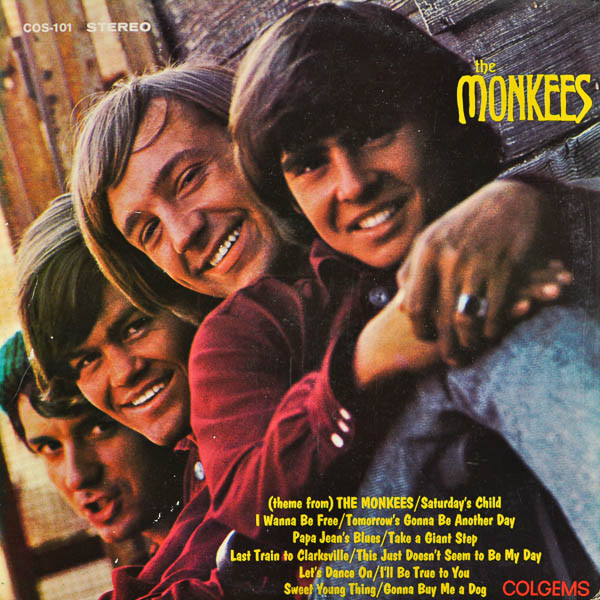
The Monkees' self-titled debut album came roaring out of RCA Victor Studios in Hollywood in the summer of 1966, shaped by the guiding hands of producers Tommy Boyce, Bobby Hart, and the formidable Don Kirshner, the man they called the King of Rock and Roll — a master architect of pop. Released on October 10, 1966 through Colgems Records, this record was built as the sonic companion to the NBC television series bearing the same name, a calculated and brilliantly executed marriage of the small screen and the record shop. Behind the glass, it was largely seasoned session musicians laying down the tracks rather than the four young men whose faces graced the sleeve — Micky Dolenz, Davy Jones, Michael Nesmith, and Peter Tork — a fact that would simmer beneath the surface and eventually boil over into one of the most talked-about controversies in pop music history. Kirshner assembled a stable of professional songwriters to craft the material, and the result was a polished, gleaming bubblegum pop record that hit the world like a thunderbolt, arriving at precisely the right moment when America was hungry for something bright, young, and irresistible.
Reception
- The album stormed the Billboard 200, climbing all the way to number one and planting its flag there for a substantial run, powered by the extraordinary momentum of the television series drawing millions of young viewers into record stores every week.
- Last Train To Clarksville, the album's lead single, shot straight to number one on the Billboard Hot 100, anchoring the album's commercial dominance and establishing The Monkees as one of the most commercially potent acts of 1966.
- The critical establishment of the era largely turned its nose up at the record, dismissing it as a manufactured confection, but the teenage audiences of America voted loudly with their dollars and made it one of the best-selling albums of the year.
Significance
- This album stands as one of the defining documents of the mid-1960s manufactured pop era, representing a pivotal moment when the machinery of television, professional songwriting, and shrewd commercial production converged to create a pop phenomenon unlike anything the industry had engineered before.
- The Monkees established a template — image-first, media-driven, songwriter-powered — that would echo forward through decades of pop history, anticipating the architecture of countless acts built on the foundation of visual exposure and behind-the-scenes creative infrastructure.
- The firestorm of debate ignited by the revelation that session musicians, not the band, performed on the record forced a serious and lasting conversation about authenticity in popular music, a question that has never truly left the room since this album first hit the shelves in the autumn of 1966.
Tracklist
-
A1 (Theme From) The Monkees 83
 2:20
2:20
-
A2 Saturday's Child 142
2:44
-
A3 I Wanna Be Free 83
2:24
-
A4 Tomorrow's Gonna Be Another Day 99
2:33
-
A5 Papa Gene's Blues 113
1:55
-
A6 Take A Giant Step 101
2:32
-
B1 Last Train To Clarksville 99
2:40
-
B2 This Just Doesn't Seem To Be My Day 112
2:08
-
B3 Let's Dance On 181
2:30
-
B4 I'll Be True To You 128
2:48
-
B5 Sweet Young Thing 106
1:54
-
B6 Gonna Buy Me A Dog 93
2:38

Artist Details
The Monkees were a pop-rock group assembled in Los Angeles in 1965 for a television show of the same name, blending bubblegum charm with genuine musical chops to create a sound that had the whole country humming — hits like Last Train to Clarksville and I'm a Believer weren't just songs, baby, they were moments frozen in time. Though the music industry initially dismissed them as a manufactured act, these four cats — Davy Jones, Micky Dolenz, Michael Nesmith, and Peter Tork — pushed back hard, fought for creative control, and proved they had real soul beneath all that prefab shine. Culturally, they were the bridge between the British Invasion and the psychedelic era, and their influence on the idea of pop as spectacle — music, television, and personality all wrapped into one — echoes all the way down to the present day.