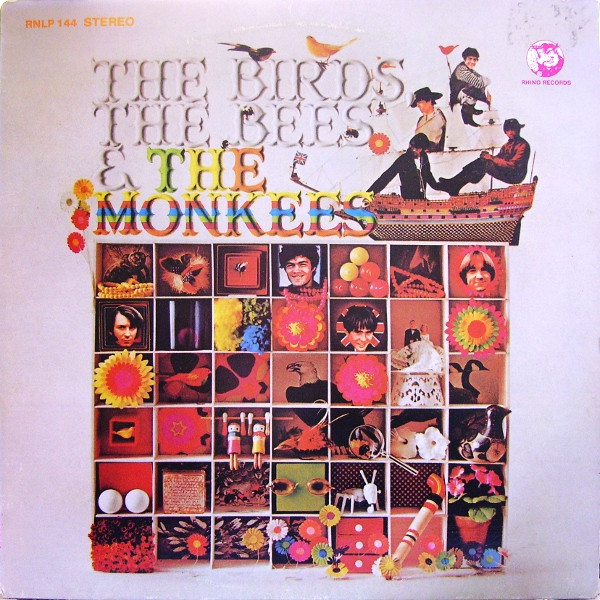
The Birds, The Bees & The Monkees
 View on Discogs
 View on Wikipedia
Album Summary
The Birds, The Bees & The Monkees came rolling out of Colgems Records in April of 1968, and honey, this was not the same Monkees the world thought it knew. Recorded during a period of hard-won creative liberation, the album found Davy Jones, Micky Dolenz, Michael Nesmith, and Peter Tork each stepping into the producer's chair for their own tracks — a direct result of the group's determined break from the assembly-line pop machinery that had previously governed their sound. What emerged was a beautifully unruly record, stitching together psychedelia, country, avant-garde experimentation, and pure pop craft into something that refused to sit still. The band was navigating the fading glow of their television fame while simultaneously reaching for something deeper and more personal, and that tension lives inside every groove of this album. It was a statement, plain and simple — made by four young men who had something to say and finally had the freedom to say it.
Reception
- The album reached number 3 on the Billboard 200, a strong showing that nonetheless signaled a commercial shift from the stratospheric heights of the group's earlier releases.
- The single Valleri proved to be a genuine pop force, climbing to number 3 on the Billboard Hot 100 and giving the album a commercial anchor that connected with the group's broad fan base.
- Critical reception at the time was mixed, with some ears tuned in to the adventurous spirit of the record while others found its wide stylistic range more scattered than inspired.
Significance
- The album stands as one of the clearest early examples in mainstream pop of a manufactured act seizing full creative control, with each member producing his own material — a move that carried real weight in the evolving dialogue about artist autonomy in the music industry.
- Released in the thick of 1968, the record's restless genre-blending — touching psychedelia, country-rock, and experimental pop within a single LP — made it a genuine reflection of the musical upheaval reshaping that extraordinary year.
- The Monkees used this album as a direct and earnest answer to the cultural demand that pop acts prove their artistic legitimacy, and the sincerity of that effort gives the record a place in the larger story of how pop music grew up in the late 1960s.
Tracklist
-
A1 Dream World 132
 3:16
3:16
-
A2 Auntie's Municipal Court 96
3:55
-
A3 We Were Made For Each Other 97
2:24
-
A4 Tapioca Tundra 165
3:03
-
A5 Daydream Believer 129
2:58
-
A6 Writing Wrongs 136
5:06
-
B1 I'll Be Back Up On My Feet 104
2:32
-
B2 The Poster 114
2:16
-
B3 P.O. Box 9847 206
3:18
-
B4 Magnolia Simms 134
3:42
-
B5 Valleri 152
2:16
-
B6 Zor And Zam 181
2:08

Artist Details
The Monkees were a pop-rock group assembled in Los Angeles in 1965 for a television show of the same name, blending bubblegum charm with genuine musical chops to create a sound that had the whole country humming — hits like Last Train to Clarksville and I'm a Believer weren't just songs, baby, they were moments frozen in time. Though the music industry initially dismissed them as a manufactured act, these four cats — Davy Jones, Micky Dolenz, Michael Nesmith, and Peter Tork — pushed back hard, fought for creative control, and proved they had real soul beneath all that prefab shine. Culturally, they were the bridge between the British Invasion and the psychedelic era, and their influence on the idea of pop as spectacle — music, television, and personality all wrapped into one — echoes all the way down to the present day.