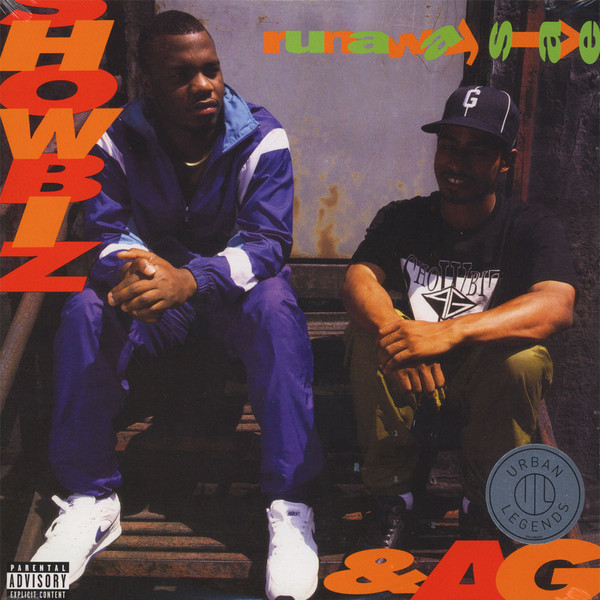
Runaway Slave
 View on Discogs
 View on Wikipedia
Album Summary
Out of the Bronx, New York, in 1992 came one of the purest expressions of underground hip-hop that decade would ever know — Runaway Slave, the debut album from the duo Showbiz & A.G., released through Payday/London Records. Showbiz, one of the most gifted beat architects to ever dig through a crate, handled the lion's share of production, sculpting a record dense with soulful samples and that unmistakable boom-bap thump that made the streets of New York feel alive in your speakers. His partner, MC Andre the Giant — A.G. — brought a lyrical sharpness and street wisdom that cut straight to the bone. The album was born out of the D.I.T.C. — Diggin' in the Crates — collective, that sacred circle of New York hip-hop talent, and fellow D.I.T.C. brethren Diamond D and Lord Finesse were right there in the mix, lending their presence to a record that felt like a family affair from the very first note.
Reception
- Runaway Slave earned deep respect and critical praise within hip-hop circles upon its release, celebrated for A.G.'s introspective and razor-sharp lyricism alongside Showbiz's thick, sample-heavy production that embodied the New York underground sound.
- The album did not break through to mainstream chart success, but it built a devoted cult following that only grew stronger with time, and retrospective critical assessments have consistently lifted it up as an overlooked classic of early 1990s East Coast hip-hop.
- Hip-hop historians and publications have repeatedly pointed to this record as a benchmark of the underground New York scene of its era, a record that wore its authenticity like a badge of honor.
Significance
- Runaway Slave stands as a cornerstone of the D.I.T.C. collective's legacy — a record that helped establish and codify the boom-bap aesthetic that would serve as the backbone of New York underground hip-hop throughout the entire decade of the 1990s.
- Showbiz's deep crate-digging and soulful sample-flipping on this album exemplified the artistry and reverence for Black music history that defined the greatest hip-hop production of the early 1990s, and his work here left a lasting imprint on a generation of producers who followed in his footsteps.
- With its title and lyrical themes rooted in the African American experience and the weight of systemic struggle, Runaway Slave carries cultural significance that reaches well beyond its sonic achievements — it is a document of a people, a place, and a moment in time that demanded to be heard.
Samples
- Fat Pockets — sampled by various artists within the underground hip-hop community, recognized as one of the standout Showbiz productions from this album with a noted sampling legacy among boom-bap producers.
- Bounce Ta This — sampled by producers drawing from the D.I.T.C. sound, carrying forward the soulful swing of Showbiz's original construction.
- Still Diggin' — cited among collectors and producers as a source track that has found its way into later hip-hop productions paying homage to the D.I.T.C. era.
Tracklist
-
A1 Still Diggin' 93
 3:42
3:42
-
A2 Fat Pockets 131
3:37
-
A3 Bounce Ta This 96
3:49
-
A4 Runaway Slave 90
4:49
-
A5 Hard To Kill 93
5:12
-
B1 40 Acres And My Props 95
4:19
-
B2 Hold Ya Head 98
4:36
-
B3 Silence Of The Lambs (Remix) 98
5:53
-
B4 More Than One Way Out Of The Ghetto 95
5:07
-
B5 He Say, She Say 100
4:02

Artist Details
Showbiz & A.G. are a hip-hop duo out of the Bronx, New York, who came together in the early 1990s and became cornerstones of the raw, underground East Coast sound that was keeping it real while the industry started chasing shine. Their 1992 debut EP *Soul Clap* and the 1995 follow-up album *Runaway Slave* — dropped through Payday Records and featuring production from the legendary D.I.T.C. crew — showcased Showbiz's hard-hitting, jazz-and-soul-laced beats alongside A.G.'s sharp, streetwise lyricism, cementing their place as architects of authentic New York hip-hop. They may not have grabbed the mainstream spotlight, but among heads who knew, Showbiz & A.G. were the real deal, deeply influential in shaping the gritty, sample-driven aesthetic that defined the golden era and earned them enduring respect in hip-hop's underground canon.