The Low End Theory
 View on Discogs
 View on Wikipedia
Album Summary
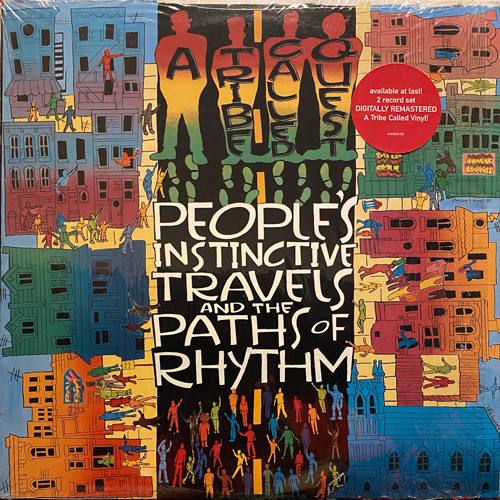
Now let me tell you something, because this is important — The Low End Theory didn't just arrive, it descended. Recorded in 1990 through 1991 and released on September 24, 1991, through Jive Records, this sophomore masterpiece from Q-Tip, Phife Dawg, Ali Shaheed Muhammad, and Jarobi White was something the culture had been waiting for without even knowing it. The production came largely from within — Q-Tip and Ali Shaheed Muhammad holding it down with that deep, warm, bass-forward vision — with the legendary Ron Carter lending his upright bass to grace these sessions with genuine jazz lineage. Building on the promise of their 1990 debut People's Instinctive Travels and the Paths of Rhythm, the group went into the studio and came out with something that felt like it had always existed, like it was pulled from the cosmos fully formed.
Reception
- The Low End Theory achieved platinum certification in the United States, a commercial leap that proved A Tribe Called Quest had transcended buzz and become a genuine force in the culture.
- The album peaked at #45 on the Billboard 200 and reached #6 on the Billboard Top R&B/Hip-Hop Albums chart, earning crossover recognition that matched its critical reverence.
- Critics embraced it immediately and have never let it go — widely celebrated as one of the greatest hip-hop albums ever recorded, praised for its bass-heavy production, jazz sensibility, and the lyrical interplay between Q-Tip and Phife Dawg.
Significance
- The Low End Theory stands as one of the defining monuments of the Native Tongues Collective's golden era, cementing the philosophy that hip-hop could be simultaneously street-wise, intellectually rich, and deeply rooted in Black musical tradition.
- By stripping the production down to bass, drums, and carefully chosen jazz samples, the album elevated hip-hop's relationship with jazz from mere borrowing to genuine dialogue — a conversation between generations of Black artistry that changed what producers believed was possible.
- The album set a new standard for what a hip-hop group could aspire to be, shifting the genre's center of gravity toward introspective lyricism and musicianship, and its influence can be heard in virtually every jazz-rap and alternative hip-hop record that followed in the decades since.
Samples
- Excursions — one of the most revisited tracks in hip-hop sampling culture, built on a bass loop that producers across multiple generations have drawn from and paid homage to.
- Buggin' Out — sampled across numerous hip-hop productions, its infectious groove and energy made it a go-to source for artists seeking that raw early-90s New York feel.
- Check The Rhime — sampled by various artists drawn to its bright horn stabs and effortless swing, one of the more recognizable sonic signatures on the album.
- Scenario — the closing posse cut became a touchstone track whose elements, particularly its high-energy momentum and horn samples, have been revisited by hip-hop producers paying tribute to the Tribe legacy.
- Verses From The Abstract — featuring Ron Carter's live bass performance, this track has been sampled and interpolated by artists drawn to its rare blend of live jazz instrumentation and hip-hop production.
Tracklist
-
A1 Excursions 95
 3:53
3:53
-
A2 Buggin' Out 96
3:38
-
A3 Rap Promoter 97
2:13
-
A4 Butter 92
3:39
-
B1 Verses From The Abstract 87
3:59
-
B2 Show Business 101
3:53
-
B3 Vibes And Stuff 92
4:18
-
C1 The Infamous Date Rape 188
2:54
-
C2 Check The Rhime 96
3:36
-
C3 Everything Is Fair 97
2:59
-
D1 Jazz (We've Got) 92
4:09
-
D2 Skypager 97
2:13
-
D3 What? 110
2:29
-
D4 Scenario 101
4:10

Artist Details
A Tribe Called Quest — oh, what a beautiful thing they gave this world — was a hip-hop quartet born out of Queens, New York, coming together in 1985 and blessing the airwaves with their debut in 1990, weaving jazz samples, Afrocentric consciousness, and laid-back rhymes into something the streets had never quite felt before, creating what the people came to call jazz rap or alternative hip-hop. Q-Tip, Phife Dawg, Ali Shaheed Muhammad, and Jarobi White didn't just make music — they shifted the entire cultural temperature of hip-hop, proving that Black artistry could be both deeply intellectual and undeniably funky, influencing generations of artists from Kendrick Lamar to J. Cole. Their classic run of albums, especially *People's Instinctive Travels*, *The Low End Theory*, and *Midnight Maraudon*, stand as sacred texts in the hip-hop canon, cementing A Tribe Called Quest as architects of a sound and a spirit that the world is still catching up to.