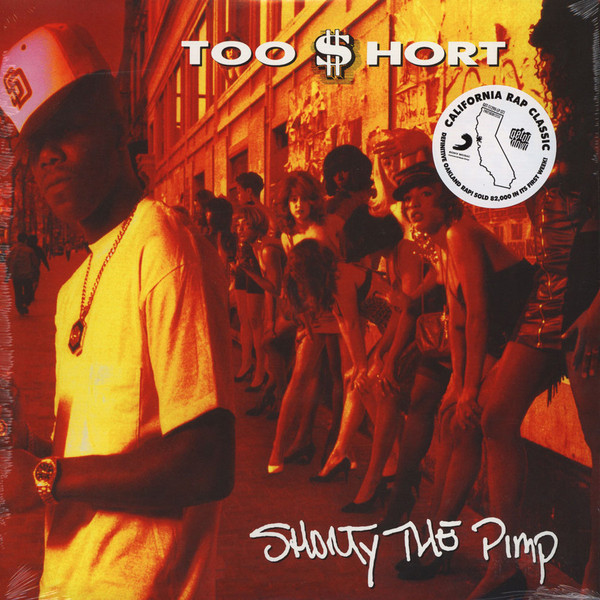
Shorty The Pimp
 View on Discogs
 View on Wikipedia
Album Summary
Shorty The Pimp dropped in 1992 on Jive Records, and it was Too Short doing what Too Short does — raw, unfiltered, and unapologetic street poetry straight out of Oakland, California. Produced by Too Short himself alongside his longtime collaborator Ant Banks, this record was laid down with that slow, syrupy West Coast funk that became the man's signature sound. By this point in his career, Too Short had already built a loyal following through years of grinding on the underground tape circuit, and Jive was giving him the platform to let that Oakland spirit breathe on a bigger stage. The album arrived right in the thick of the West Coast rap explosion, and Short Dogg brought every bit of his pimped-out, street-level storytelling to the table — no apologies, no compromises, just the game as he saw it from the Bay.
Reception
- Shorty The Pimp performed solidly on the charts, debuting and charting on the Billboard 200 and the Top R&B/Hip-Hop Albums chart, consistent with Too Short's established commercial pull at the time.
- Critics recognized the album as a continuation of Too Short's unapologetic Bay Area style, with his frank lyricism and funk-heavy production drawing both admiration and controversy in equal measure.
- The record was embraced enthusiastically by the West Coast hip-hop community, reinforcing Too Short's status as one of the founding voices of the Oakland rap scene.
Significance
- Shorty The Pimp stands as a defining document of early 1990s West Coast rap, capturing the raw street-level perspective of Oakland at a moment when the city's hip-hop identity was crystallizing on the national stage.
- The album's unapologetic exploration of pimp culture, street life, and West Coast funk helped cement Too Short as one of the architects of a distinctly Bay Area voice — separate and sovereign from both New York and Los Angeles.
- Tracks like 'So You Want To Be A Gangster' and 'No Love From Oakland' reflect the social tensions and hard realities of urban Black life in the early nineties, giving the album a cultural weight that goes beyond its surface-level swagger.
Samples
- In The Trunk — sampled by various West Coast artists paying homage to Too Short's trunk-rattling Oakland aesthetic, becoming one of the more referenced cuts from this project in regional hip-hop.
- It Don't Stop — noted for its looping funk bed that has been picked up and flipped by producers working in the West Coast gangsta rap and hyphy traditions.
Tracklist
-
A1 Intro: Shorty The Pimp —
 0:42
0:42
-
A2 In The Trunk —
5:50
-
A3 I Ain't Nothin' But A Dog —
4:49
-
A4 Hoes —
6:23
-
A5 No Love From Oakland —
8:25
-
A6 I Want To Be Free (That's The Truth) —
5:51
-
B1 Hoochie —
4:19
-
B2 Step Daddy —
4:23
-
B3 It Don't Stop —
4:21
-
B4 So You Want To Be A Gangster —
4:04
-
B5 Something To Ride To —
11:58
-
B6 Extra Dangerous Thanks —
4:10

Artist Details
Too Short, born Todd Anthony Shaw, rose up out of the gritty streets of Oakland, California in the early 1980s and became one of the founding fathers of West Coast rap, laying down that slow, hypnotic pimp-funk groove long before the mainstream even knew what hit em. This brother was independently hustling his tapes out of car trunks before most labels even understood what hip-hop could be, and his unapologetically explicit, street-level storytelling carved out a lane that would influence generations of West Coast and Southern rap artists from Snoop Dogg to the entire hyphy movement. Too Short's decades-long career and his Oakland roots made him a cultural cornerstone, proving that authentic, regional voices could build empires on their own terms.