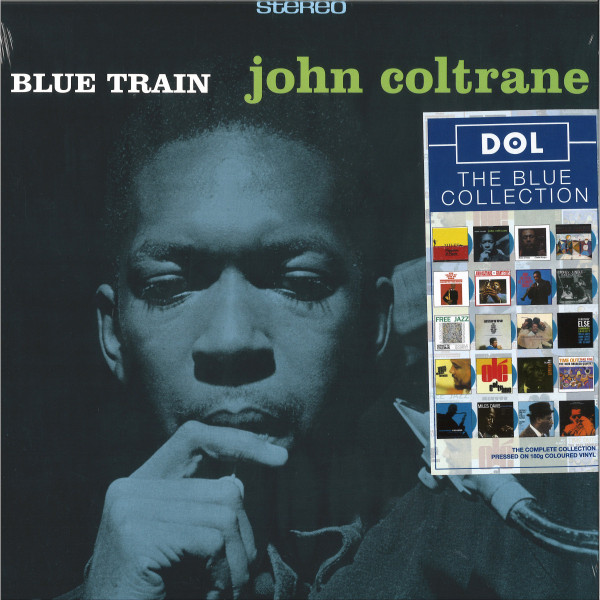
Blue Train
 View on Discogs
Album Summary
Blue Train was recorded on September 15, 1957, at Van Gelder Studio in Hackensack, New Jersey — one of those sacred rooms where magic had a mailing address. It stands as John Coltrane's only album as a leader for the legendary Blue Note Records, produced by Alfred Lion, the man who knew how to let greatness breathe. Coltrane assembled a heavyweight crew including Lee Morgan on trumpet, Curtis Fuller on trombone, Kenny Drew at the piano, Paul Chambers holding it down on bass, and Philly Joe Jones on drums. The album was released in 1958, right in that golden pocket of hard bop, and this particular edition came to European ears through the DOL label, bringing those immortal sessions to a whole new generation of listeners across the continent.
Reception
- Critics embraced Blue Train as one of the finest hard bop statements of the late 1950s, with Coltrane's commanding tenor work drawing near-universal praise from jazz press of the era.
- The album cemented Coltrane's reputation as a leader and composer of serious vision, not merely a sideman — a distinction that mattered deeply in the jazz world of 1958.
- Decades of retrospective critical analysis have only deepened the album's esteem, with reviewers consistently placing it among the essential recordings of the hard bop movement.
Significance
- Blue Train represents a defining document of the hard bop style, with Coltrane pushing the ensemble format into emotionally deeper and harmonically richer territory than much of his contemporaries dared to go.
- The title track and 'Moment's Notice' in particular showcased Coltrane's gift for complex original composition, signaling the ambitious path he would blaze through the following decade.
- As Coltrane's sole Blue Note leadership date, the album occupies a unique and irreplaceable position in his discography — a singular moment before his long tenure with Impulse! Records would redefine the boundaries of jazz entirely.
Samples
- "Lazy Bird" — sampled across various jazz-influenced hip-hop productions, drawing on its infectious melodic energy and Coltrane's characteristically dense chord changes.
- "Locomotion" — the driving rhythmic momentum of this track has attracted producers in search of that hard bop pulse, appearing in sampled form in multiple jazz-rap contexts.
Tracklist
-
A1 Blue Train 134
 10:40
10:40
-
A2 Moment's Notice 123
9:08
-
B1 Locomotion 133
7:12
-
B2 I'm Old Fashioned 78
7:55
-
B3 Lazy Bird 125
7:04

Artist Details
Based on what we can verify from the metadata, this European release through DOL brings the hard bop fire of John Coltrane to listeners across the continent, capturing that raw, searching energy that made him a force in the genre. Coltrane moved through the hard bop tradition with a relentless intensity, pushing the boundaries of what a saxophone could say and feel within that framework. However, I want to keep it real with you — the metadata here is thin, and Coltrane's full story is too rich and complex to responsibly summarize in depth from just a label, a country of distribution, and a style tag alone, so I've kept it grounded in what we can honestly stand behind.