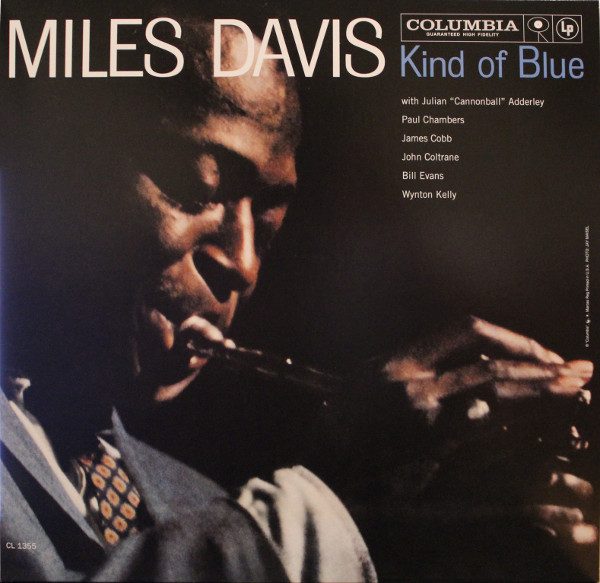
Kind Of Blue
 View on Discogs
 View on Wikipedia
Album Summary
Recorded in just two legendary sessions at Columbia's 30th Street Studio in New York City — March 2 and April 22, 1959 — Kind Of Blue was produced by Irving Townsend and released by Columbia Records later that same year. Miles Davis gathered one of the most luminous ensembles in jazz history for those dates, and what unfolded in that studio was less a conventional recording session and more a quiet revolution. The players came in with skeletal modal sketches rather than dense chord charts, and what they laid down was largely first-take magic — spontaneous, breathing, alive.
Reception
- Kind Of Blue was met with immediate critical acclaim upon its 1959 release, with jazz critics recognizing it as a bold departure from the bebop conventions that had defined the decade.
- The album found both critical and commercial favor, reaching audiences far beyond the traditional jazz listenership and cementing Miles Davis as one of the most forward-thinking voices in American music.
- Decades after its release, Kind Of Blue has been consistently ranked by music publications and historians as one of the greatest albums ever recorded across any genre.
Significance
- Kind Of Blue stands as the defining document of modal jazz — a style that freed improvisers from rapid chord changes and invited them instead to explore the emotional and melodic possibilities of scales and modes, opening up a whole new universe of sound.
- The album's five tracks, including the stately opener 'So What' and the hauntingly beautiful 'Blue In Green,' demonstrated that jazz could be simultaneously intellectually groundbreaking and deeply, soulfully accessible to the human ear.
- Kind Of Blue reshaped the trajectory of jazz in the late 20th century and beyond, influencing not only jazz musicians but composers, rock artists, and entire generations of listeners who found in its unhurried, meditative grooves something that felt like breathing itself.
Samples
- So What — one of the most recognized modal jazz compositions ever recorded, its bassline and melodic motif have been sampled and interpolated across hip-hop and R&B, with notable use by artists including Nas.
- Freddie Freeloader — sampled in various hip-hop productions, with its bluesy, laid-back groove making it a recurring source for producers seeking warmth and authenticity.
- All Blues — its distinctive waltz-feel riff has been lifted and referenced by hip-hop and soul producers across multiple decades, appreciated for its hypnotic, rolling quality.
Tracklist
-
A1 So What 136
 9:22
9:22
-
A2 Freddie Freeloader 128
9:46
-
A3 Blue In Green 112
5:37
-
B1 All Blues 139
11:33
-
B2 Flamenco Sketches 177
9:26

Artist Details
Miles Davis was an American jazz visionary who recorded for the legendary Columbia label, bringing his groundbreaking modal approach to a wide and devoted audience across the United States. His exploration of modal music helped push the boundaries of jazz into deeply meditative, emotionally expansive territory that felt as much like a spiritual journey as it did a sonic one. Davis left an undeniable mark on the landscape of American music, crafting a sound so cool and deliberate that it could stop a room cold and warm a soul simultaneously.