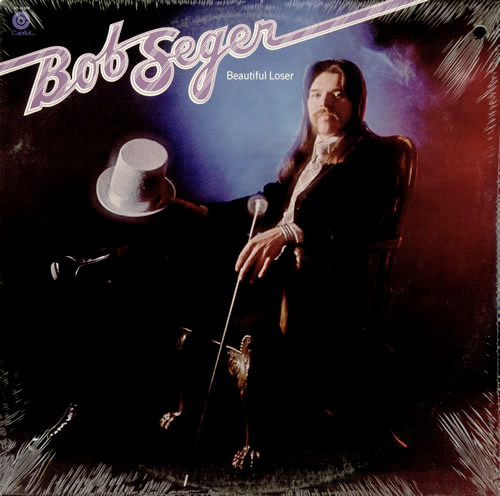
Beautiful Loser
 View on Discogs
 View on Wikipedia
Album Summary
Beautiful Loser was tracked in 1974 and released in April 1975 on Capitol Records, produced by Bob Seger alongside his long-time manager and creative partner Punch Andrews. The sessions were built largely around the Silver Bullet Band, and brother, you could feel the difference — this was Seger locking in, finding that sweet spot between raw Detroit grit and something tighter, more intentional. For years Seger had been burning up the Midwest circuit, pouring everything he had into stages from Ohio to Michigan, and this record was the moment all that road-worn wisdom started crystallizing into something the rest of the country couldn't ignore. The blues-soaked, heartland rock sound captured here was no accident — it was the sound of a man who had earned every note, and Seger and Andrews knew exactly what they were sculpting in those sessions.
Reception
- Beautiful Loser landed at number 131 on the Billboard 200 upon release, a modest chart showing that reflected Seger's still-regional footprint at the time — but those numbers don't tell the whole story of what this record set in motion.
- Critics who paid attention noted Seger's uncommonly honest vocal delivery and his rare gift for crafting narratives that felt lived-in and true, even if the national press hadn't fully come around to the man from Detroit just yet.
- The title track received meaningful FM radio airplay that slowly stretched Seger's audience past the Midwest and started building the kind of grassroots momentum that would carry him straight into the commercial stratosphere within the next two years.
Significance
- Beautiful Loser stands as one of the essential waypoints in Seger's artistic journey, the record where the blue-collar rock identity fully cohered and pointed a clear path toward the landmark albums that would follow and shape American heartland rock for a generation.
- The album deepened and proved the creative partnership between Seger and Punch Andrews, a collaboration that became one of the most consequential relationships in the Detroit rock world throughout the 1970s.
- The record's unflinching themes of perseverance, quiet dignity, and ordinary American life struck something real in working-class audiences navigating a turbulent mid-1970s, cementing Seger's standing as one of the most authentic voices that decade produced.
Tracklist
-
A1 Beautiful Loser 117
 3:26
3:26
-
A2 Black Night 118
3:19
-
A3 Katmandu 140
6:08
-
A4 Jody Girl 109
3:38
-
B1 Travelin' Man 119
2:41
-
B2 Momma 149
3:21
-
B3 Nutbush City Limits 165
3:52
-
B4 Sailing Nights 68
3:16
-
B5 Fine Memory 151
2:58

Artist Details
Oh baby, let me tell you about the one and only Bob Seger, a gritty, heartland rock poet born and raised in Detroit, Michigan, who started grinding out his blue-collar anthems back in the mid-1960s before hitting his stride with the Silver Bullet Band in the early 1970s, blending hard rock, heartland rock, and soul-drenched R&B into a sound that felt like a cold Michigan night and a warm whiskey all at once. Seger's raw, raspy voice and working-class storytelling made classics like Night Moves, Turn the Page, and Old Time Rock and Roll into the soundtrack of an entire generation of American dreamers, truckers, and lovers, earning him a rightful place in the Rock and Roll Hall of Fame in 2004. More than just a rock star, Seger became a symbol of authentic, no-frills American rock music at a time when the industry was getting flashy, reminding everybody that the real power was always in the honest, unpolished truth of the human experience.