Wednesday Morning, 3 A.M.
 View on Discogs
 View on Wikipedia
Album Summary
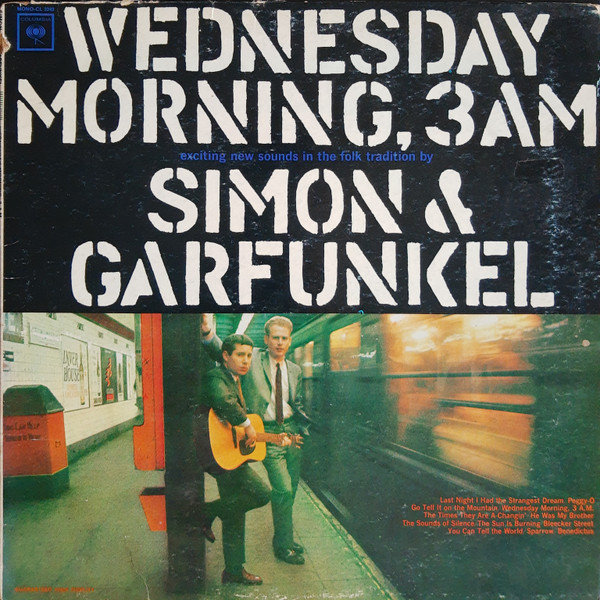
Back in 1964, two young cats from Queens stepped into the studio and laid down something that the world wasn't quite ready for yet — but the world would catch up. "Wednesday Morning, 3 A.M." was the debut album from Paul Simon and Art Garfunkel, released on Columbia Records under the steady hand of producer Tom Wilson. Recorded with a purity and simplicity that spoke directly to the soul of the early 1960s folk revival, the album was a showcase of acoustic guitar arrangements, poetic lyricism, and those two voices weaving together like they were born to harmonize. Tom Wilson, who had an ear for artists on the edge of something great, captured Simon and Garfunkel in their most unadorned form — raw, honest, and deeply rooted in the folk tradition that was coursing through Greenwich Village and college coffeehouses across America at the time.
Reception
- The album landed with a quiet thud upon its 1964 release, selling in numbers so modest that Columbia essentially shelved it — the world was still figuring out what it wanted, and it hadn't yet realized it wanted this.
- The entire story changed when producer Tom Wilson took "The Sounds Of Silence" from this very album, overdubbed it with electric instrumentation, and released it in 1965 — that record climbed the charts and suddenly everyone needed to go back and find where Simon and Garfunkel had come from.
- Critical reassessment over the years has been generous and well-deserved, with music historians recognizing the album as a genuinely promising debut that captured two extraordinary talents at the very beginning of their journey.
Significance
- "Wednesday Morning, 3 A.M." stands as a vital document of the early 1960s folk revival, placing Simon and Garfunkel squarely in the tradition of acoustic storytelling at a moment when that tradition was about to be electrified and transformed into something the whole world would embrace.
- The album established the artistic DNA of Simon and Garfunkel — introspective, poetic lyrics wrapped in close vocal harmonies so precise and so achingly beautiful that no amount of rock instrumentation could ever fully eclipse them — and that identity would carry them through the rest of the decade.
- By including both original compositions and interpretations of folk and spiritual material, the album reflected the full spirit of the folk movement's belief that song was a living, communal art form, connecting Simon and Garfunkel to a tradition far older and deeper than pop radio.
Tracklist
-
A1 You Can Tell The World 121
 2:44
2:44
-
A2 Last Night I Had The Strangest Dream 80
2:09
-
A3 Bleecker Street 100
2:41
-
A4 Sparrow 130
2:47
-
A5 Benedictus 133
2:37
-
A6 The Sounds Of Silence 106
3:05
-
B1 He Was My Brother 201
2:48
-
B2 Peggy-O —
2:32
-
B3 Go Tell It On The Mountain 121
2:04
-
B4 The Sun Is Burning 122
2:47
-
B5 The Times They Are A-Changin' —
2:50
-
B6 Wednesday Morning, 3 A.M. 105
2:13

Artist Details
Simon & Garfunkel — that's Paul Simon and Art Garfunkel, baby — came together in the early 1960s right out of Queens, New York, weaving folk, pop, and a little rock and roll into some of the most achingly beautiful harmonies this world has ever heard, giving us timeless masterpieces like "The Sound of Silence," "Mrs. Robinson," and "Bridge Over Troubled Water" that spoke straight to the soul of a generation wrestling with war, change, and the search for meaning. These two cats became the soundtrack of the 1960s counterculture movement, their music threading through the threads of social unrest, love, and longing in ways that made them not just musicians, but poets of their time. Even after they went their separate ways in 1970, their legacy never faded — because when the music is that real, that honest, it just doesn't die.