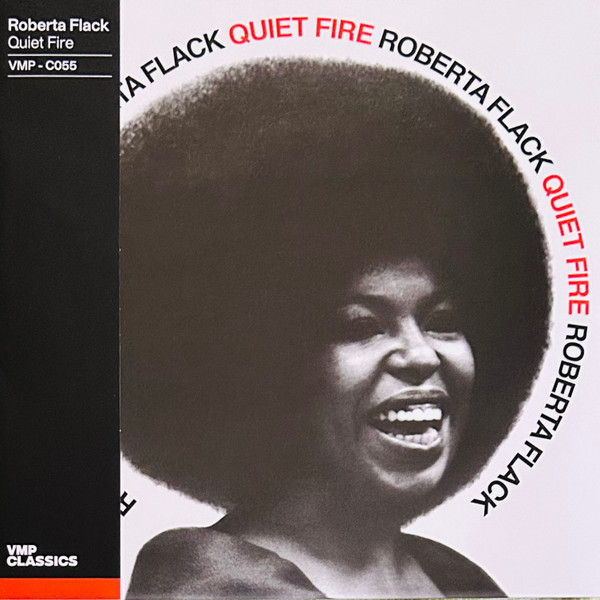
Quiet Fire
 View on Discogs
 View on Wikipedia
Album Summary
Quiet Fire arrived in 1971 on Atlantic Records, the second studio album from the incomparable Roberta Flack, and honey, it was everything her debut promised and then some. Once again helmed by producer Joel Dorn, a man who truly understood how to frame that voice like a painting, the album drew from the same well of intimate, piano-centered sophistication that had first turned heads on First Take. Flack brought her classical training and her deep soulful instincts to these sessions, wrapping her warm, unhurried delivery around a set of songs that ranged from gospel-tinged originals to reimagined pop and soul standards. Atlantic gave her the room to breathe, and she used every inch of it.
Reception
- Quiet Fire earned warm critical admiration for Flack's interpretive depth and musicianship, with reviewers consistently pointing to her vocal restraint and control as qualities that set her apart from her contemporaries in soul and R&B.
- The album was not a mass commercial breakthrough in the traditional sense, but it deepened Flack's devoted cult following among listeners who craved something more thoughtful and unhurried than what the pop charts typically offered.
- Jazz and adult contemporary critics in particular celebrated the album's understated elegance, reinforcing Flack's standing as one of the most emotionally nuanced vocalists of the early 1970s.
Significance
- Quiet Fire stands as one of the earliest and most fully realized expressions of what would later be called the quiet storm aesthetic — a sound that wove together soul, jazz, gospel, and folk into something reflective and deeply interior, laying groundwork that adult contemporary and neo-soul artists would draw from for decades to come.
- The album showcases Flack's extraordinary gift for transformation, particularly on 'Will You Still Love Me Tomorrow' and 'To Love Somebody,' where she takes songs already beloved by millions and makes them feel entirely her own through phrasing, pacing, and the profound intimacy of her piano accompaniment.
- As the follow-up to First Take, Quiet Fire was a critical moment in cementing the artistic identity Roberta Flack would carry through her most celebrated work — proving that her debut was no accident and that she was building something lasting, something that belonged entirely to her.
Tracklist
-
A1 Go Up Moses 98
 5:20
5:20
-
A2 Bridge Over Troubled Water 73
7:13
-
A3 Sunday And Sister Jones 143
4:48
-
A4 See You Then 126
3:40
-
B1 Will You Still Love Me Tomorrow 91
3:59
-
B2 To Love Somebody 121
6:41
-
B3 Let Them Talk 135
3:50
-
B4 Sweet Bitter Love 141
6:06

Artist Details
Roberta Flack, born in Black Mountain, North Carolina in 1937 and raised in Arlington, Virginia, was a classically trained pianist and vocalist who emerged from the Washington D.C. jazz club scene in the late 1960s to become one of the most soulful, tender voices of her generation — her silky blend of soul, R&B, jazz, and pop touching hearts in ways that few artists ever could. She burst into the national consciousness with her breathtaking 1972 smash "The First Time Ever I Saw Your Face," a song that moved so slow and so deep it felt like time itself stopped, followed by the unforgettable "Killing Me Softly With His Song" in 1973, earning her back-to-back Grammy Awards for Record of the Year — a feat that had never been accomplished before. Roberta Flack wasn't just making music; she was creating intimate, cinematic experiences that spoke to the beauty and pain of love, and her artistry helped pave the way for sophisticated Black female artists who refused to be put in any one box.