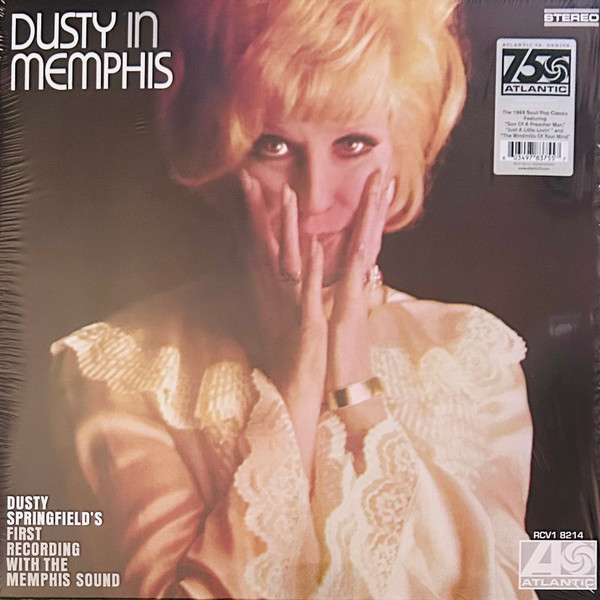
Dusty In Memphis
 View on Discogs
Album Summary
Recorded in Memphis, Tennessee in 1968 at the legendary American Sound Studio, 'Dusty In Memphis' found the British soul queen Dusty Springfield working under the guiding hands of producers Jerry Wexler, Arif Mardin, and Tom Dowd — the same wizards who shaped so much of what made Atlantic Records the house of soul. The sessions brought Springfield into the orbit of the Muscle Shoals-adjacent musicians who gave the record its warm, unhurried Southern groove, though Springfield herself, overcome with nerves in the studio, reportedly recorded most of her vocals back in New York, layering her voice over the Memphis tracks. Atlantic released the album in early 1969, presenting the world with something that felt both intimate and cinematic — a white English girl from Hampstead finding her deepest, most honest voice somewhere along the banks of the Mississippi.
Reception
- Upon its release, 'Dusty In Memphis' was met with widespread critical admiration, though it performed modestly on the charts at the time, underlining the classic truth that some records are ahead of their moment.
- The album's lead single 'Son Of A Preacher Man' became a genuine hit, giving the record its commercial anchor and introducing mainstream audiences to the album's soulful southern sound.
- Over the decades, critical reassessment elevated 'Dusty In Memphis' to near-universal acclaim, with it now widely regarded as one of the greatest vocal albums ever recorded.
Significance
- The album stands as a landmark moment of transatlantic soul, demonstrating that the emotional truth at the heart of Southern R&B could be channeled through an artist regardless of geography or background, expanding the very definition of what soul music could be.
- Springfield's collaboration with the Atlantic production team on this record represents one of the finest examples of the Memphis soul aesthetic — spare, warm arrangements placing the human voice above all else — captured at the very peak of that tradition.
- The record has endured as a touchstone for singers and producers across generations, its combination of pop songcraft and deep soul feeling making it a defining document of late 1960s American music culture.
Samples
- "Son Of A Preacher Man" — one of the most recognizable samples in pop and hip-hop history, famously featured in Quentin Tarantino's Pulp Fiction soundtrack and sampled and interpolated across numerous productions over the decades.
- "Breakfast In Bed" — the song and its melodic elements have been revisited and interpolated by various artists drawn to its warm, intimate groove.
- "Just A Little Lovin'" — sampled and referenced by producers seeking that lush, orchestrated Atlantic soul atmosphere that opens the album.
Tracklist
-
A1 Just A Little Lovin' 111
 2:15
2:15
-
A2 So Much Love 90
3:28
-
A3 Son Of A Preacher Man 89
2:19
-
A4 I Don't Want To Hear It Anymore 82
3:06
-
A5 Don't Forget About Me 127
2:49
-
A6 Breakfast In Bed 79
2:54
-
B1 Just One Smile 89
2:37
-
B2 The Windmills Of Your Mind 154
3:48
-
B3 In The Land Of Make Believe 110
2:28
-
B4 No Easy Way Down 138
3:08
-
B5 I Can't Make It Alone 85
3:47

Artist Details
Dusty Springfield was a magnificent British soul singer born Mary Isobel Catherine Bernadette O'Brien in London in 1939, who rose to fame in the early 1960s and became one of the most powerful white voices in soul and pop music the world had ever heard, blessed with a smoky, aching delivery that could break your heart in sixteen bars. She crossed the Atlantic and planted herself firmly in the American soul tradition, recording her masterpiece *Dusty in Memphis* in 1969 with some of the finest session musicians in the South, a record so deep and so real it sits right alongside anything Aretha or Otis ever touched. Dusty shattered barriers for women in music, lived boldly and authentically at a time when the world wasn't always ready for it, and left behind a catalog of pure feeling that still moves the soul like Sunday morning light coming through stained glass.