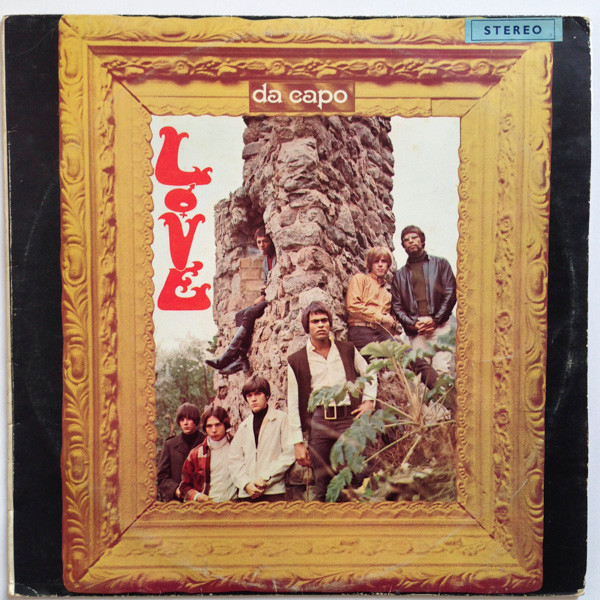
Da Capo
 View on Discogs
 View on Wikipedia
Album Summary
Da Capo was laid down in 1966 and came on out to the world in April of 1967 on Elektra Records — and baby, when it dropped, Los Angeles was never quite the same. Produced by the band themselves alongside the gifted engineer Bruce Botnick, this was Love's second studio offering, and it found Arthur Lee and his crew stretching their wings in ways that made everybody sit up and pay attention. Recorded right in the heart of the Los Angeles psychedelic rock scene at its most gloriously restless, Da Capo was the sound of a band outgrowing conventional song forms in real time, pushing into territory that nobody — and this DJ means nobody — had quite mapped out before. From the polished, hook-laden gems on side one to the sprawling, side-long improvisation that closes the record, Da Capo is a document of a band in magnificent, beautiful transition.
Reception
- Da Capo reached number 32 on the Billboard 200, giving Love their strongest chart showing to that point and proving that adventurous music could find a real audience.
- Critics of the era praised Arthur Lee's increasingly experimental songwriting and the album's bold psychedelic direction, recognizing something genuinely new was happening in those grooves.
- The side-long track 'Revelation' split opinion hard — some called it self-indulgent, others called it visionary — but nobody could ignore it, and that tension is exactly what great art creates.
Significance
- Da Capo stands as one of the defining artifacts of West Coast psychedelic rock, threading the needle between accessible pop songcraft and fearless acid-drenched experimentation in a way that opened doors for everyone who followed.
- The album is a landmark in the history of rock music as one of the earliest psychedelic records led by a Black artist achieving mainstream recognition, with Arthur Lee's vision challenging and expanding the perceived boundaries of who this music belonged to.
- With its side-long improvisation and refusal to play it safe, Da Capo is widely regarded as a forerunner of progressive rock, planting seeds that would flower throughout the late 1960s and well into the 1970s.
Samples
- Seven & Seven Is — one of the most recognized tracks from the album, its relentless fuzz-driven energy has drawn the attention of samplers across rock and electronic music contexts over the decades.
Tracklist
-
A1 Stephanie Knows Who 117
 2:33
2:33
-
A2 Orange Skies 111
2:49
-
A3 ¡Que Vida! 126
3:37
-
A4 Seven & Seven Is —
2:15
-
A5 The Castle 96
3:00
-
A6 She Comes In Colors 128
2:43
-
B Revelation 78
18:57

Artist Details
Love was a groundbreaking Los Angeles rock group formed in 1965, led by the visionary Arthur Lee, blending psychedelic rock, folk, blues, and baroque pop into a sound so rich and layered it made your soul stand still — their 1967 masterpiece Forever Changes is widely considered one of the greatest albums ever recorded, a swirling, orchestrated meditation on love, mortality, and the unraveling of the '60s dream. What makes Love's story all the more remarkable and heartbreaking is that despite their genius, they remained largely a cult phenomenon, never quite breaking through to the mainstream success they deserved, yet their influence quietly seeped into the DNA of rock and pop music for decades to come.