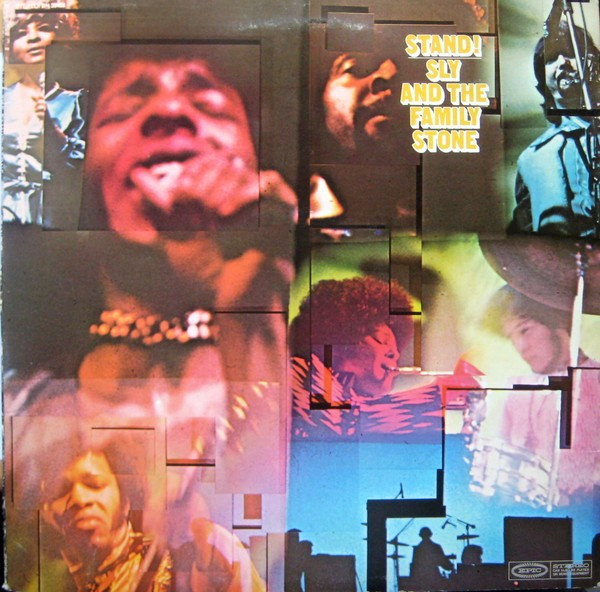
Stand!
 View on Discogs
 View on Wikipedia
Album Summary
Recorded at the legendary Record Plant Studios in Los Angeles and released by Epic Records in May 1969, "Stand!" was produced entirely by the visionary Sly Stone himself — a man who heard the future before anyone else had the ears for it. This was Sly & The Family Stone at the absolute summit of their powers, channeling the restless energy of a nation in transformation into something that was equal parts sermon, celebration, and sonic revolution. The psychedelic soul movement had found its prophet, and this album was his gospel. Every track crackles with the conviction of a band that knew — deep in their bones — that they were making history.
Reception
- The album peaked at No. 13 on the Billboard 200, a remarkable achievement for a record so uncompromising in its vision and so boldly political in its message.
- "Everyday People" was released as a single ahead of the album and soared to No. 1 on the Billboard Hot 100, becoming one of the defining anthems of its era and one of the band's most enduring signatures.
- The album also reached No. 1 on the R&B Albums chart, confirming that Sly & The Family Stone had not just crossed genre boundaries — they had obliterated them.
Significance
- "Stand!" stands as the crowning achievement of the psychedelic soul movement, weaving rock instrumentation, gospel fire, and funk rhythm into a seamless whole that no artist before them had dared to attempt with such fearless ambition.
- At a moment when America was torn apart by racial strife and social upheaval, Sly Stone used this album as a vehicle for unity and hope — tracks like "Everyday People" and "You Can Make It If You Try" carried a message of togetherness across racial and social lines that felt both urgent and transcendent.
- The integrated lineup of Sly & The Family Stone — Black and white, men and women, playing together as equals — was itself a radical act in 1969, and this album cemented their legacy as one of the most culturally significant groups in the history of American music.
Samples
- "Everyday People" — one of the most sampled soul records in hip-hop history, with interpolations and samples appearing across decades of recordings by major artists, its opening bass line and vocal hook woven into the very fabric of the genre.
- "Stand!" — the title track's horn stabs and rhythm section have been lifted and repurposed by hip-hop and R&B producers seeking that raw, righteous energy that only Sly Stone could conjure.
- "I Want To Take You Higher" — its infectious groove and horn breaks have attracted samplers across multiple genres, drawn to the track's irresistible momentum and jubilant energy.
- "Sing A Simple Song" — the drum breaks and funky instrumental passages have made this track a favorite source for producers mining the golden era of late-1960s soul and funk.
- "Don't Call Me Nigger, Whitey" — its raw, confrontational groove has been sampled by hip-hop artists drawn to both its sonic power and its unflinching social commentary.
Tracklist
-
A1 Stand! 108
 3:08
3:08
-
A2 Don't Call Me Nigger, Whitey 100
5:59
-
A3 I Want To Take You Higher 103
5:22
-
A4 Somebody's Watching You 117
3:19
-
A5 Sing A Simple Song 99
3:55
-
B1 Everyday People 117
2:20
-
B2 Sex Machine 85
13:48
-
B3 You Can Make It If You Try 101
3:39

Artist Details
Sly & The Family Stone burst onto the scene out of San Francisco in 1966, led by the visionary Sylvester Stewart — better known as Sly Stone — and they cooked up a sound so rich and revolutionary it made the whole world get up and dance, blending funk, soul, rock, and psychedelia into something nobody had ever heard before. This group was a trailblazer not just musically but socially, putting together one of the first racially and gender-integrated bands in popular music and delivering anthems like "Everyday People" and "Thank You" that spoke truth to a nation caught in the fire of the Civil Rights Movement and counterculture revolution. Their influence runs so deep it flows through the veins of Prince, Earth Wind & Fire, and Parliament-Funkadelic, and any serious student of soul and funk music knows that without Sly & The Family Stone, the whole landscape of popular music would look and sound completely different.