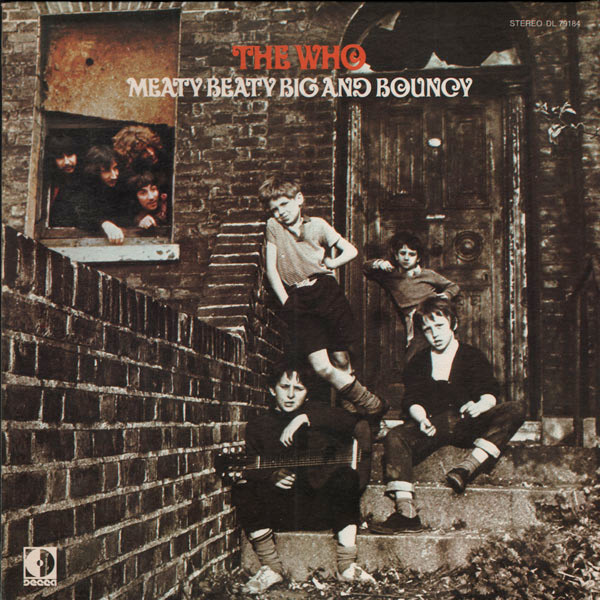
Meaty Beaty Big And Bouncy
 View on Discogs
Album Summary
Meaty Beaty Big And Bouncy is a compilation album released by Decca Records in 1971, and baby, this record is nothing short of a love letter to everything The Who stood for in their prime. Rather than a freshly recorded studio affair, this collection was assembled from the band's previously released singles and B-sides spanning roughly 1965 through 1970 — the kind of raw, explosive recordings that used to shake the walls of every club from London to Los Angeles. There was no single producer behind the board for this project in the traditional sense, as the tracks had been captured across various sessions over the years, each one a snapshot of a band that was always pushing harder, always reaching further. The album arrived at a moment when the world needed reminding just how dangerous and beautiful The Who could be, and Decca delivered that reminder with both barrels.
Reception
- The album charted respectably in the United Kingdom, reaching number 9 on the British charts and planting itself firmly in the Top 10.
- It became one of The Who's best-selling compilations of the early 1970s, proving that the singles market had given birth to some of the most enduring rock and roll of the decade.
Significance
- Meaty Beaty Big And Bouncy stands as a definitive document of The Who's mod-era greatness, tracing the band's artistic journey from the raw, snarling urgency of 'My Generation' through the psychedelic ambition of 'I Can See For Miles' — a progression that few bands of that era could match.
- The collection captures the full emotional and sonic range of one of rock's most combustible units, from the tender gender-bending storytelling of 'I'm A Boy' to the thunderous pinball mythology of 'Pinball Wizard,' demonstrating that Pete Townshend was already one of the most daring songwriters alive.
- For an entire generation of listeners who came to The Who through the grandeur of Tommy and Who's Next, this album served as the essential gateway back to the band's scrappy, defiant singles roots — a reminder that the revolution started in the three-minute format long before the concept albums arrived.
Samples
- My Generation — one of the most referenced tracks in rock history, its opening riff and rebellious spirit have been sampled and interpolated across hip-hop and alternative music for decades.
- Pinball Wizard — sampled and replayed across numerous recordings, its distinctive acoustic-driven intro has made it a touchstone for artists drawing from classic rock's catalog.
- The Seeker — has seen use in various sampled contexts, with its driving rhythm track attracting the attention of producers mining the classic rock era.
- Magic Bus — its hypnotic, percussive groove has been sampled by hip-hop and electronic artists drawn to its raw rhythmic momentum.
Tracklist
-
A1 I Can't Explain —
 2:05
2:05
-
A2 The Kids Are Alright 134
2:42
-
A3 Happy Jack —
2:14
-
A4 I Can See For Miles 129
3:55
-
A5 Pictures Of Lily —
2:37
-
A6 My Generation 96
3:15
-
A7 The Seeker —
3:12
-
B1 Anyway, Anyhow, Anywhere —
2:35
-
B2 Pinball Wizard 61
3:00
-
B3 A Legal Matter 104
2:47
-
B4 Boris The Spider 98
2:26
-
B5 The Magic Bus —
4:28
-
B6 Substitute —
3:47
-
B7 I'm A Boy —
3:42

Artist Details
The Who burst onto the scene out of London, England back in 1964, bringing with them a raw, explosive brand of rock and roll that hit harder than anything coming out of Britain at the time — Pete Townshend's windmill power chords, Keith Moon's thunderous drumming, and Roger Daltrey's lion-roar vocals made them a force of nature unlike any other. They pioneered the rock opera with albums like Tommy and Quadrophenia, proving that rock music could tell deep, complex stories while still making you want to tear the roof off the joint. Their anthems of youth rebellion — My Generation, Baba O'Riley, Won't Get Fooled Again — didn't just soundtrack a generation, they defined what it meant to be young and restless, cementing The Who as one of the most important and electrifying bands in the history of rock and roll.