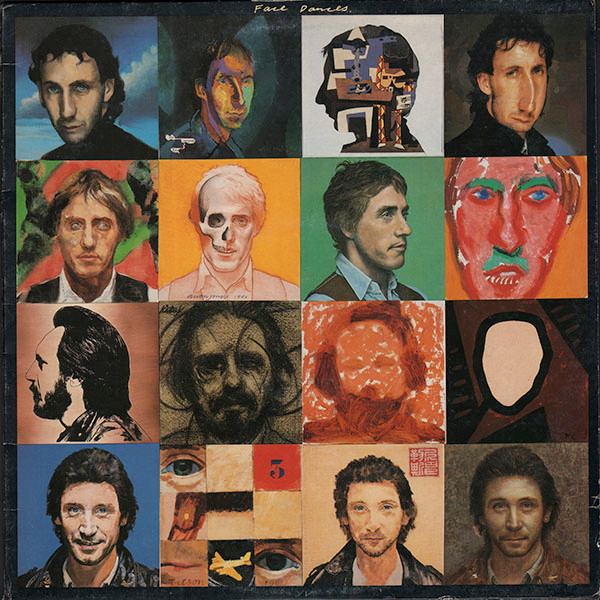
Face Dances
 View on Discogs
 View on Wikipedia
Album Summary
Face Dances was laid down in 1980 and came rolling out to the world in March of 1981 on Polydor Records in the UK and Warners stateside — and baby, this was a moment that carried some real weight. Produced by The Who themselves alongside the legendary Glyn Johns, with Bill Curbishley holding things together behind the scenes, this was the band stepping back into the studio and facing a world that had changed on them. Keith Moon was gone, and the great Kenney Jones had settled in behind the kit, bringing a steadier, more measured feel to the rhythm section. That shift — quiet as it was — changed the whole sonic personality of the record. This was The Who in transition, walking into the new decade with something to prove, and the result was an album that sounded like a band wrestling beautifully with itself.
Reception
- Face Dances climbed to number two on the UK Albums Chart and landed at number thirteen on the Billboard 200, proving the faithful were still showing up even if the critical world was giving the band the side-eye.
- The album's lead single 'You Better You Bet' broke through in a serious way, reaching number eighteen on the Billboard Hot 100 and cementing itself as one of the band's most recognizable tracks of the entire 1980s.
- Critical reception landed somewhere between respectful and skeptical, with reviewers acknowledging Pete Townshend's craft while questioning whether The Who's fire still burned hot enough to compete in a landscape suddenly overrun by synthesizers and new wave energy.
Significance
- Face Dances stands as a genuine document of rock royalty attempting to find their footing in a seismic cultural shift — the MTV era was arriving, new wave was rewriting the rulebook, and The Who were navigating all of it in real time, right there in the grooves.
- Pete Townshend's songwriting across this record — from the urgent drive of 'You Better You Bet' to the introspective 'Don't Let Go The Coat' — revealed an artist still reaching, still searching, even as the band's internal dynamics had fundamentally changed with Kenney Jones anchoring the rhythm.
- The album captures a pivotal tension that defined many great rock acts of the era: the struggle between honoring a legendary identity and embracing the sonic vocabulary of a new decade, making Face Dances as historically telling as it is musically engaging.
Tracklist
-
A1 You Better You Bet 161
 5:38
5:38
-
A2 Don't Let Go The Coat 126
3:43
-
A3 Cache Cache 164
3:56
-
A4 The Quiet One 109
3:08
-
A5 Did You Steal My Money 130
4:11
-
B1 How Can You Do It Alone 131
5:28
-
B2 Daily Records 132
3:27
-
B3 You 156
4:31
-
B4 Another Tricky Day 113
4:53

Artist Details
The Who burst onto the scene out of London, England back in 1964, bringing with them a raw, explosive brand of rock and roll that hit harder than anything coming out of Britain at the time — Pete Townshend's windmill power chords, Keith Moon's thunderous drumming, and Roger Daltrey's lion-roar vocals made them a force of nature unlike any other. They pioneered the rock opera with albums like Tommy and Quadrophenia, proving that rock music could tell deep, complex stories while still making you want to tear the roof off the joint. Their anthems of youth rebellion — My Generation, Baba O'Riley, Won't Get Fooled Again — didn't just soundtrack a generation, they defined what it meant to be young and restless, cementing The Who as one of the most important and electrifying bands in the history of rock and roll.