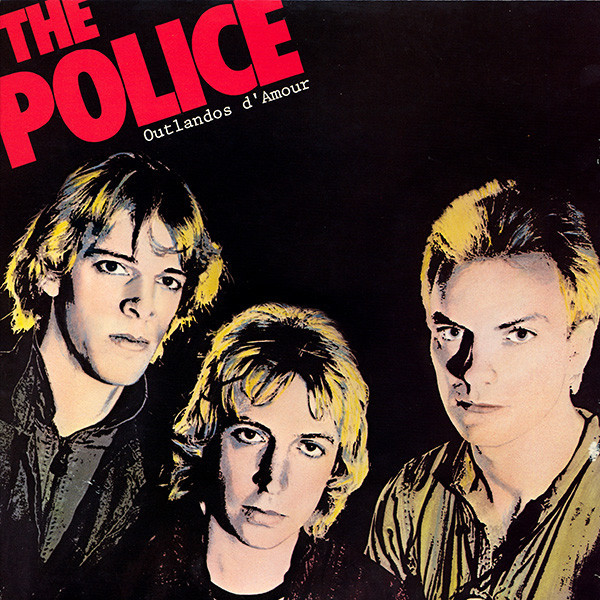
Outlandos D'Amour
 View on Discogs
 View on Wikipedia
Album Summary
Outlandos d'Amour came roaring out of the gate in 1978 on A&M Records, and honey, this was not your typical major-label debut. The Police — that lean, mean trio of Sting, Andy Summers, and Stewart Copeland — largely took the production reins themselves alongside engineer and co-producer Nigel Gray, cutting this record on a shoestring budget at Surrey Sound Studios in Leatherhead, England. What they lacked in dollars, they more than made up for in raw nerve and vision. This was a band that had something to say and knew exactly how to say it, fusing the raw urgency of punk with the hypnotic pulse of reggae and the sharp intelligence of new wave into something that had simply never been heard before. The world wasn't quite ready, but the world was about to get schooled.
Reception
- The album climbed to number six on the UK Albums Chart, a remarkable achievement for a debut record made on a modest budget, signaling that The Police were a force the music world could not ignore.
- Critical reception was a mixed bag at first — some reviewers were slow to recognize the genius, dismissing the band as a passing novelty — but the voices of praise grew louder as the album's staying power became undeniable.
- The single Roxanne became the album's breakthrough moment, earning significant radio play across formats and introducing the band's unmistakable sound to international audiences who would carry that groove with them for decades.
Significance
- Outlandos d'Amour stands as a landmark fusion record, threading together punk aggression, reggae rhythm, and new wave melody in a way that cracked open the post-punk landscape and showed a whole generation of musicians that the rules were theirs to rewrite.
- The album's spare, rhythmically driven production — lean and purposeful, never cluttered — set a new standard for intelligent rock music, proving that three people with the right chemistry could fill a room more powerfully than a full orchestra.
- Sting's songwriting throughout the album introduced a literary and emotionally complex voice into a genre that didn't always make room for nuance, helping to elevate new wave from a stylistic moment into a genuinely substantive artistic movement.
Samples
- Roxanne — one of the most recognizable tracks in the new wave canon, with its chord progression and melodic identity appearing in numerous hip-hop and pop productions; widely interpolated and referenced across popular culture including a prominent use in the Moulin Rouge! film soundtrack.
Tracklist
-
A1 Next To You 86
 2:50
2:50
-
A2 So Lonely 77
4:49
-
A3 Roxanne 136
3:12
-
A4 Hole In My Life 146
4:52
-
A5 Peanuts 181
3:58
-
B1 Can't Stand Losing You 144
2:58
-
B2 Truth Hits Everybody 164
2:53
-
B3 Born In The 50's 141
3:40
-
B4 Be My Girl - Sally —
3:22
-
B5 Masoko Tanga 144
5:40

Artist Details
The Police were a smooth but electric three-piece outfit that came together in London in 1977, blending punk energy, reggae grooves, and new wave sophistication into something the world had never quite heard before — Sting on bass and vocals, Andy Summers on guitar, and Stewart Copeland holding it all down on drums like only he could. They rode that sound all the way to the top of the charts on both sides of the Atlantic, dropping classics like Roxanne, Every Breath You Take, and Message in a Bottle before calling it quits in 1986 at the very peak of their powers. Their legacy sits tall in the history books as one of the defining acts of the early '80s, proving that intelligence, restraint, and a little Caribbean rhythm could cut through the noise and reach millions of souls hungry for something real.