Cosmo's Factory
 View on Discogs
 View on Wikipedia
Album Summary
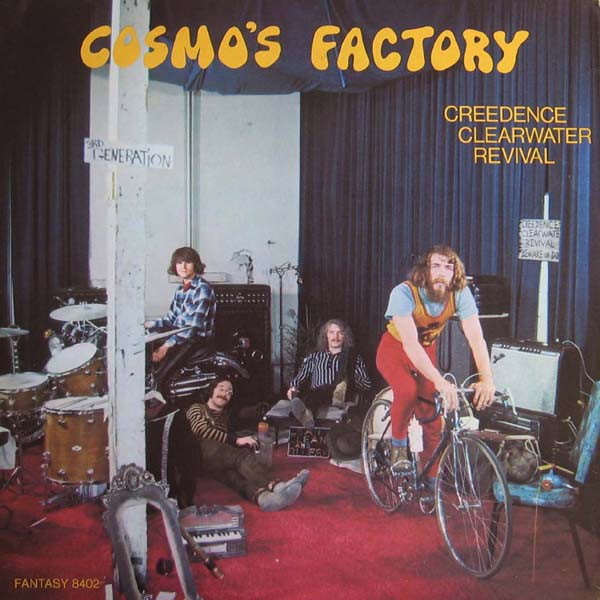
Cosmo's Factory came roaring out of the Fantasy Records stable in July of 1970, recorded at Wally Heider's Studio in San Francisco with the band's own John Fogerty sitting in the producer's chair — a man who knew exactly what he wanted and wasn't about to let anybody else tell him different. The album took its name from the warehouse rehearsal space where CCR would grind out hours and hours of practice, a place the band called 'the factory' after drummer Doug Clifford's nickname 'Cosmo.' That work ethic bleeds through every groove on this record, a tight, road-hardened outfit playing with the kind of locked-in confidence you only get from a band that has been living inside the music day and night.
Reception
- Cosmo's Factory reached number one on the Billboard 200 albums chart in the United States and performed similarly well in the UK and Australia, becoming one of the best-selling albums of 1970.
- Critics of the era responded with genuine enthusiasm, praising the album's remarkable range — from swampy Southern rock to tender ballads — and the sheer productivity of a band releasing music at such a relentless pace without any drop in quality.
- The album generated multiple hit singles, with both 'Lookin' Out My Back Door' and 'Who'll Stop The Rain' charting strongly, cementing CCR's commercial dominance at the turn of the decade.
Significance
- Cosmo's Factory stands as one of the defining documents of the swamp rock and roots rock movement, a record that drew deeply from American blues, rockabilly, and country without ever feeling like a museum piece — it was alive, urgent, and thoroughly of its moment.
- The album's sprawling cover of 'I Heard It Through The Grapevine,' stretching past eleven minutes, announced that CCR could hold down a long-form, trance-like groove with the best of them, expanding the sonic vocabulary people associated with the band.
- Released at the height of the Vietnam War era, tracks like 'Who'll Stop The Rain' and 'Run Through The Jungle' resonated with a generation living under the shadow of the draft, giving Cosmo's Factory a cultural weight that extended far beyond the pop charts and into the conscience of a nation.
Samples
- Who'll Stop The Rain — sampled and interpolated across multiple recordings over the decades, with the song's melody and lyrical hook appearing in various hip-hop and rock contexts as shorthand for Vietnam-era disillusionment.
- Lookin' Out My Back Door — sampled in multiple hip-hop productions, with its bright, bouncy guitar figure proving an attractive source for producers seeking a nostalgic, feel-good texture.
- Up Around The Bend — has been drawn upon by hip-hop and rap producers for its driving, percussive intro and rhythm track.
- Travelin' Band — the raw, raucous energy of its opening has made it a source for producers seeking a gritty, classic rock punch in sample-based tracks.
Tracklist
-
A1 Ramble Tamble 103
 7:09
7:09
-
A2 Before You Accuse Me 117
3:24
-
A3 Travelin' Band 161
2:07
-
A4 Ooby Dooby 95
2:05
-
A5 Lookin' Out My Back Door 103
2:31
-
A6 Run Through The Jungle 136
3:09
-
B1 Up Around The Bend 129
2:40
-
B2 My Baby Left Me 117
2:17
-
B3 Who'll Stop The Rain 123
2:28
-
B4 I Heard It Through The Grapevine 117
11:05
-
B5 Long As I Can See The Light 127
3:33

Artist Details
Creedence Clearwater Revival was a swamp rock powerhouse born out of El Cerrito, California in 1967, fronted by the incomparable John Fogerty, whose gritty, bayou-soaked voice made you forget those boys never actually set foot in Louisiana. They fused rock and roll, blues, and country into something raw and honest — delivering stone-cold classics like Proud Mary, Bad Moon Rising, and Fortunate Son with a blue-collar urgency that cut straight through the glitter and excess of the late '60s and early '70s. CCR stood as a musical anchor during one of America's most turbulent eras, and their songs became the soundtrack of Vietnam, protest, and the working man's soul — records that still hit just as hard today as the first time they dropped the needle.