Mardi Gras
 View on Discogs
 View on Wikipedia
Album Summary
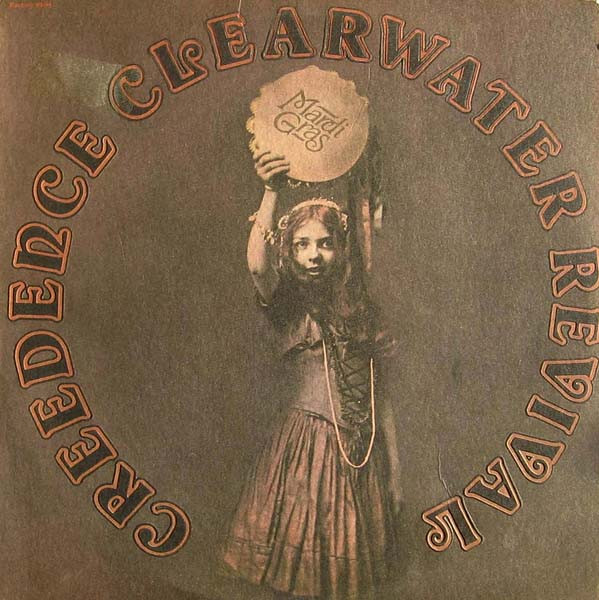
Mardi Gras was recorded in 1971 and released on April 12, 1972, through Fantasy Records, and it stands as the final studio album from one of the most electrifying rock and roll outfits the world had ever seen — Creedence Clearwater Revival. By the time these sessions came together, the band had already lost rhythm guitarist Tom Fogerty, who walked out in 1971, leaving the group a three-piece. What followed was one of the most painful creative negotiations in rock history: frontman, visionary, and driving force John Fogerty reluctantly agreed to divide songwriting and lead vocal duties equally among himself, bassist Stu Cook, and drummer Doug Clifford. Produced collectively by the band — a jarring departure from John Fogerty's iron-handed solo command over the boards — the album bears the weight of that compromise in every groove. The magic was still flickering, but the fire that had lit up the late 1960s was burning low, and the world could feel it.
Reception
- Mardi Gras peaked at number 12 on the Billboard 200, a commercially modest showing that stood in stark contrast to the band's earlier chart dominance and signaled that the CCR phenomenon was winding down.
- Critical reception was largely brutal, with reviewers zeroing in on the forced equal-contribution format as a fundamental creative misstep — Cook and Clifford's songwriting and vocal turns made painfully clear just how much of CCR's greatness had lived inside John Fogerty alone.
- The album sold respectably on the strength of a loyal fanbase, but it was widely regarded as a disappointment, and Creedence Clearwater Revival disbanded later that same year in 1972, leaving Mardi Gras as a bittersweet farewell from one of rock's most dominant acts.
Significance
- Mardi Gras endures as a powerful and sobering document of creative dysfunction, a real-time recording of what happens when a singular artistic vision is diluted by internal politics and forced democratic compromise.
- The album's ill-fated equal-songwriting experiment became a cautionary tale etched into rock history, cited time and again in conversations about band leadership, creative control, and the cost of letting boardroom politics override artistic truth.
- As the closing chapter of Creedence Clearwater Revival's remarkable five-year run, Mardi Gras holds an irreplaceable place in the story of classic rock — a melancholy final statement from a band that had defined Southern-inflected rock and roll for a generation.
Tracklist
-
A1 Lookin' For A Reason 121
 3:25
3:25
-
A2 Take It Like A Friend 112
3:01
-
A3 Need Someone To Hold 89
2:59
-
A4 Tearin' Up The Country 126
2:13
-
A5 Someday Never Comes 136
3:59
-
B1 What Are You Gonna Do 178
2:51
-
B2 Sail Away 119
2:25
-
B3 Hello Mary Lou 103
2:11
-
B4 Door To Door 126
2:07
-
B5 Sweet Hitch-Hiker —
2:59

Artist Details
Creedence Clearwater Revival was a swamp rock powerhouse born out of El Cerrito, California in 1967, fronted by the incomparable John Fogerty, whose gritty, bayou-soaked voice made you forget those boys never actually set foot in Louisiana. They fused rock and roll, blues, and country into something raw and honest — delivering stone-cold classics like Proud Mary, Bad Moon Rising, and Fortunate Son with a blue-collar urgency that cut straight through the glitter and excess of the late '60s and early '70s. CCR stood as a musical anchor during one of America's most turbulent eras, and their songs became the soundtrack of Vietnam, protest, and the working man's soul — records that still hit just as hard today as the first time they dropped the needle.