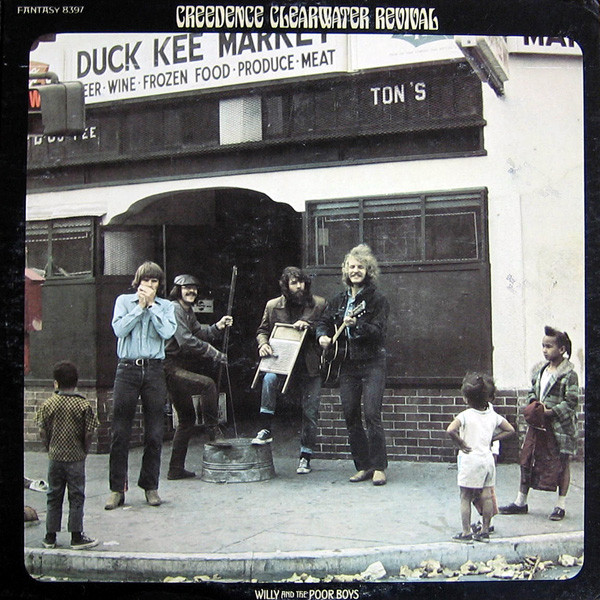
Willy And The Poor Boys
 View on Discogs
 View on Wikipedia
Album Summary
Willy and the Poor Boys was recorded at RCA Studios in Hollywood and released in November 1969 through Fantasy Records — the third full studio album that Creedence Clearwater Revival dropped in that single, staggering calendar year. Produced by the singular John Fogerty, who held the creative reins with a grip as firm as any bandleader in the business, the record came together fast, the way all the great ones do when a band is truly on fire. Fogerty steered the sessions toward something looser and earthier than what came before — a jug-band spirit ran through the grooves, raw and unpretentious, like music born on a back porch rather than polished in a penthouse studio. It was the sound of a band that trusted the song above all else, and it showed.
Reception
- The album climbed to number 3 on the Billboard 200, a testament to CCR's virtually unmatched commercial momentum during that extraordinary year of 1969.
- Critics embraced the record's roots-deep, down-home approach, with 'Down On The Corner' and 'Fortunate Son' drawing particular praise for the rare way they balanced pure musical joy with pointed, unflinching social commentary.
- 'Fortunate Son' swiftly ascended beyond chart success to become one of the most celebrated anti-Vietnam War anthems of its generation, earning the album a reverence that has only deepened with the passing decades.
Significance
- The album stands as a defining document of swamp rock and roots rock, with Fogerty and company drawing deeply from the wells of country blues, folk, and rockabilly at a moment when much of rock had drifted far into psychedelic excess and studio indulgence.
- Willy and the Poor Boys served as a proud populist counter-statement to the era's album-oriented pretension, championing working-class themes both lyrically and sonically in a way that felt genuine because it truly was.
- 'Fortunate Son' has grown into one of the most enduring protest songs in all of American popular culture, ensuring that this album carries a cultural weight and historical significance that stretches far beyond any single chart cycle or critical season.
Samples
- "Fortunate Son" — one of the most licensed and sampled protest songs in American popular culture, with its iconic opening riff and defiant energy appearing across hip-hop, film, and television productions for decades, including notable use in countless war-era documentaries and sampled by artists across multiple generations.
Tracklist
-
A1 Down On The Corner 108
 2:43
2:43
-
A2 It Came Out Of The Sky 74
2:58
-
A3 Cotton Fields 152
2:53
-
A4 Poorboy Shuffle 132
2:25
-
A5 Feelin' Blue 101
5:05
-
B1 Fortunate Son 136
2:20
-
B2 Don't Look Now (It Ain't You Or Me) —
2:08
-
B3 The Midnight Special 128
4:10
-
B4 Side O' The Road 116
3:21
-
B5 Effigy 77
6:28

Artist Details
Creedence Clearwater Revival was a swamp rock powerhouse born out of El Cerrito, California in 1967, fronted by the incomparable John Fogerty, whose gritty, bayou-soaked voice made you forget those boys never actually set foot in Louisiana. They fused rock and roll, blues, and country into something raw and honest — delivering stone-cold classics like Proud Mary, Bad Moon Rising, and Fortunate Son with a blue-collar urgency that cut straight through the glitter and excess of the late '60s and early '70s. CCR stood as a musical anchor during one of America's most turbulent eras, and their songs became the soundtrack of Vietnam, protest, and the working man's soul — records that still hit just as hard today as the first time they dropped the needle.