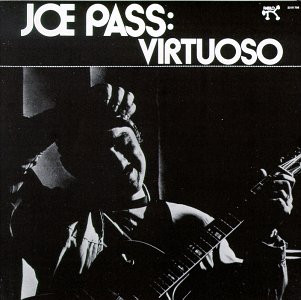
Virtuoso
 View on Discogs
 View on Wikipedia
Album Summary
On December 26th, 1973 — the day after Christmas, baby — Joe Pass walked into Whitney Recording Studio in Glendale, California, sat down with his guitar, and proceeded to lay down one of the most breathtaking solo performances jazz has ever witnessed. Just one man, one instrument, one day. No rhythm section, no overdubs, no net. The resulting album, 'Virtuoso,' was released in 1974 on Pablo Records — the label that jazz impresario and true believer Norman Granz had built as a home for straight-ahead acoustic jazz done right. Granz himself produced the session, and what he captured that day was something raw, spontaneous, and utterly unadorned — a performance that would shake the jazz guitar world to its foundation and remind everybody what this music was really about.
Reception
- Critics came out swinging with nothing but praise, hailing 'Virtuoso' as a masterpiece of solo jazz guitar upon its release — the jazz press marveled at Pass's extraordinary ability to carry melody, harmony, and rhythm simultaneously on a single instrument, with no support whatsoever, and the near-universal admiration was immediate and loud.
- The album proved to be a genuine commercial success for Pablo Records, breathing new life into the idea of solo acoustic jazz guitar at a moment when the genre was fighting hard for ears against the rising tides of rock and fusion.
- The recording earned Pass a Grammy nomination, a well-deserved tip of the hat from the industry that only added to his already towering reputation as one of the most gifted jazz guitarists alive.
Significance
- 'Virtuoso' stands as one of the most towering solo guitar recordings in all of jazz history — Pass proved beyond any doubt that a single unaccompanied guitar, in the right hands, could carry the full harmonic depth, melodic beauty, and rhythmic drive of the greatest jazz standards ever written, and he did it without a single safety net in sight.
- The album became a cornerstone release for Pablo Records, helping establish the label as the premier refuge for straight-ahead acoustic jazz at a time when major labels were turning their backs on the tradition — its existence mattered not just artistically, but as an act of cultural preservation.
- For generations of jazz guitarists who came after, 'Virtuoso' became the sacred text of solo chord-melody technique — studied, transcribed, and deeply revered as both an artistic summit and a living classroom, its influence rippling outward through the decades in ways that Joe Pass himself might never have imagined when he sat down that December afternoon.
Tracklist
-
A1 Night And Day 137
 3:32
3:32
-
A2 Stella By Starlight 81
5:11
-
A3 Here's That Rainy Day 65
3:36
-
A4 My Old Flame 70
5:18
-
A5 How High The Moon 112
5:01
-
A6 Cherokee 74
3:36
-
B1 Sweet Lorraine 137
4:08
-
B2 Have You Met Miss Jones? 142
4:42
-
B3 'Round Midnight 110
3:37
-
B4 All The Things You Are 97
4:00
-
B5 Blues For Alican 82
5:28
-
B6 The Song Is You 121
4:36

Artist Details
Joe Pass was one of the most gifted jazz guitarists to ever lay fingers on six strings, a Philadelphia-born virtuoso who spent his early years fighting personal demons before emerging in the 1960s and 70s as an absolute giant of bebop and swing, his clean-toned, impossibly fluid playing making cats like Charlie Parker and Dizzy Gillespie sound just as right on a solo guitar as they ever did with a full band behind them. His recordings for Pablo Records — especially those intimate solo albums like *Virtuoso* — redefined what a single jazz guitarist could do, stripping everything down to just the man and his instrument and leaving audiences speechless with his ability to simultaneously carry the melody, chords, and bass line without missing a single beautiful note. Pass stands as a timeless testament to the idea that true artistry needs no embellishment, and his influence echoes through every serious jazz guitarist who came after him.