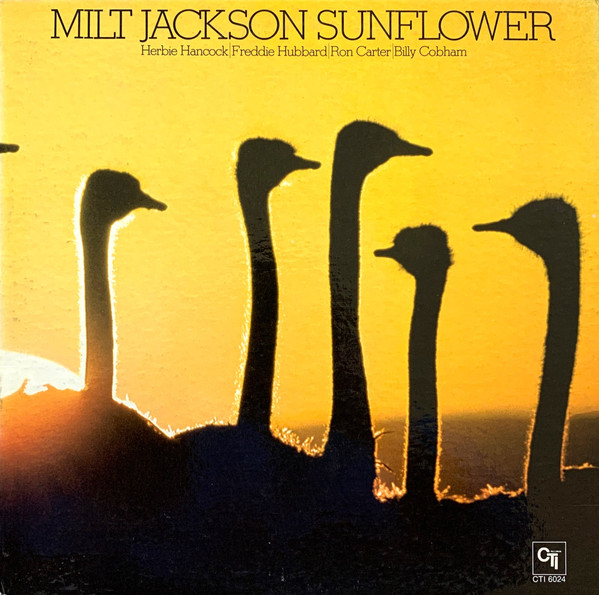
Sunflower
 View on Discogs
 View on Wikipedia
Album Summary
Milt Jackson's 'Sunflower' was laid down in 1972 and came to the people in 1973 on the legendary CTI Records — that's Creed Taylor's house, baby, the label that was redefining what jazz could sound like in the early seventies. Creed Taylor himself sat in the producer's chair, and the incomparable Don Sebesky brought those sweeping, silken string arrangements that made CTI releases feel like you were floating somewhere between a jazz club and the cosmos. Jackson's vibraphone — that warm, shimmering voice that nobody else in the world could touch — sits right at the center of it all, wrapped in orchestration so lush it practically glows. CTI had a vision: take the greatest jazz artists alive and present them in a sonic landscape that could move both the serious jazz head and the sophisticated adult listener, and with 'Sunflower,' they hit that mark with grace and soul to spare.
Reception
- The album was embraced warmly by the jazz community as a genuine showcase for Jackson's gift, with critics taking note of the expressive fluidity he brought to every moment of the session — a man utterly in command of his instrument and his art.
- Like the finest CTI releases of that golden era, 'Sunflower' rode the label's impeccable production values and strong distribution reach, finding its way to jazz listeners and adult contemporary audiences across the country.
- Reviewers consistently highlighted Jackson's rare ability to inhabit a richly orchestrated setting without losing one drop of his improvisational fire — a balance that not every bebop-rooted artist could pull off, but Milt made it look easy.
Significance
- 'Sunflower' stands as one of the purest expressions of the CTI Records sound that defined the early 1970s mainstream jazz landscape — that irresistible blend of hard bop soul and orchestral sophistication that opened jazz up to a whole new world of listeners.
- Don Sebesky's arrangements on this record are widely regarded as some of the most elegant work he contributed to the CTI catalog, cementing his legacy as a master of jazz orchestration during one of the genre's most lush and adventurous periods.
- The album captures Milt Jackson at a profound creative crossroads, standing as a testament to how the bebop generation navigated the commercially driven production currents of the early seventies without ever compromising the artistic integrity that made them legends in the first place.
Samples
- People Make The World Go Round — sampled by numerous hip-hop and R&B producers, with the track carrying a notable legacy in soul-influenced sample culture drawing from this version's orchestral warmth.
Tracklist
-
A1 For Someone I Love —
 10:08
10:08
-
A2 What Are You Doing The Rest Of Your Life? —
6:55
-
B1 People Make The World Go Round —
8:23
-
B2 Sunflower —
8:50

Artist Details
Milt Jackson, born in Detroit in 1923, was the kind of vibraphone genius who could make those metal bars sing like a gospel choir on a Saturday night, and as a founding member of the Modern Jazz Quartet in 1952, he helped shape the sound of cool jazz with a bluesy, soulful touch that set him apart from every other cat in the room. His playing bridged the gap between bebop fire and smooth, sophisticated elegance, earning him a reputation as arguably the greatest vibraphonist in jazz history, with collaborations alongside legends like Dizzy Gillespie, Charlie Parker, and Thelonious Monk cementing his place at the very top of the genre. Milt Jackson's cultural significance runs deep — he proved that jazz could be both intellectually rich and emotionally raw, and his influence can be felt in virtually every vibraphonist and jazz ensemble that came after him.