Let It Bleed
 View on Discogs
 View on Wikipedia
Album Summary
Cut across sessions at Olympic Studios in London and other locales throughout 1969, 'Let It Bleed' stands as the Rolling Stones' farewell to Decca Records — and what a farewell it was. Produced with soulful authority by Jimmy Miller, the man who understood exactly what this band needed to sound like, the album arrived in December of 1969 right at the razor's edge of the decade's closing chapter. This was the Stones at the height of their creative fire, channeling everything raw and real and dangerous about American blues and country music and wrapping it in something unmistakably their own. The timing alone gives the record a weight that never fades — dropped into a world still reeling from Altamont, still searching for something to hold onto.
Reception
- Climbed to number 1 on the UK Albums Chart and reached number 3 on the US Billboard 200, confirming the Stones' commercial dominance on both sides of the Atlantic.
- Hailed by critics as one of the greatest albums in the rock canon, celebrated as a masterpiece of blues-rock fusion that captured a band operating at their absolute peak.
- Inducted into the Grammy Hall of Fame, a formal recognition of what serious listeners already knew from the moment the needle first hit the groove.
Significance
- Represents the pinnacle of the Stones' ability to absorb the American blues and country tradition — from the Delta soul of 'Love In Vain' to the Appalachian echo of 'Country Honk' — and transform it into something urgent and distinctly their own.
- Released at the turbulent close of the 1960s counterculture, the album's tone — from the apocalyptic dread of 'Gimme Shelter' to the sprawling orchestral humanity of 'You Can't Always Get What You Want' — captured the mood of a generation watching its idealism crack and crumble.
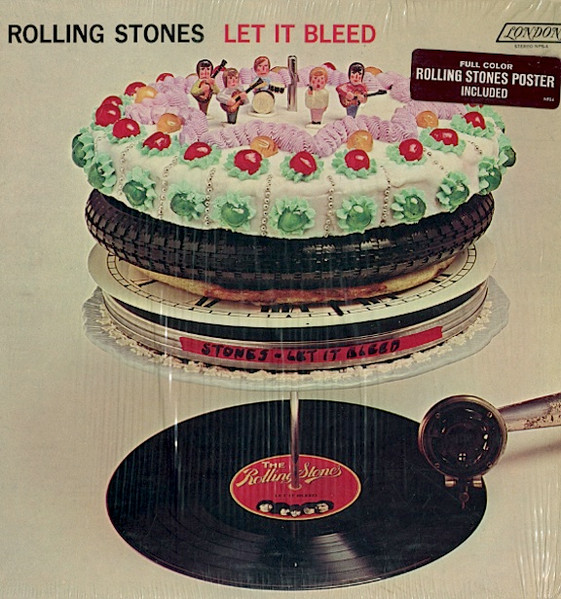
- The album's iconic cover art, featuring a layered cake adorned with grotesque imagery, reflected the era's artistic extremism and the Stones' deliberate refusal to be comfortable or comforting.
Samples
- Gimme Shelter — one of the most recognizable and heavily sampled tracks in rock history, famously interpolated and referenced across hip-hop and film scores for decades, with its opening guitar figure and Merry Clayton's vocals appearing in countless productions.
- Midnight Rambler — sampled and referenced across rock and blues-influenced hip-hop productions, valued for its menacing groove and dramatic live-wire energy.
- You Can't Always Get What You Want — its melody and lyrical refrain have been interpolated and referenced across pop, soul, and hip-hop recordings over multiple decades.
Tracklist
-
A1 Gimmie Shelter —
 4:30
4:30
-
A2 Love In Vain —
4:18
-
A3 Country Honk 120
3:00
-
A4 Live With Me 129
3:35
-
A5 Let It Bleed 117
5:27
-
B1 Midnight Rambler 150
6:52
-
B2 You Got The Silver 143
2:51
-
B3 Monkey Man 99
4:12
-
B4 You Can't Always Get What You Want 86
7:28

Artist Details
The Rolling Stones, those bad boys out of London, England, came together in 1962 and proceeded to set the world on fire with a raw, blues-drenched rock and roll sound that made even the devil himself tap his foot — Mick Jagger's swagger, Keith Richards' riffs, and that whole crew built something dangerous and beautiful that the world wasn't quite ready for. They stood toe-to-toe with the Beatles as the defining force of the British Invasion, but where the Fab Four gave you sunshine, the Stones handed you a little darkness, a little soul, a little street — and the world ate it up like gospel. Decades deep into their run, with classics like "Paint It Black," "Gimme Shelter," and "Sympathy for the Devil" permanently etched into the fabric of rock history, the Rolling Stones remain a living, breathing monument to the power of music that refuses to be tamed.