Time Further Out (Miro Reflections)
 View on Discogs
Album Summary
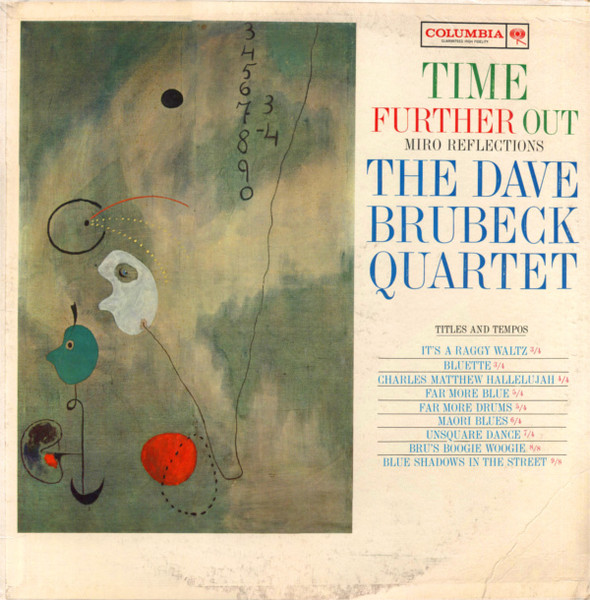
Time Further Out (Miro Reflections) came out of the Columbia Records sessions in 1961, riding the coattails of one of the most beloved jazz records ever pressed — the quartet's landmark Time Out. Produced by Columbia's jazz division, this record found Dave Brubeck, Paul Desmond, Eugene Wright, and Joe Morello stepping back into the studio with that same fearless spirit, determined to prove that Time Out was no happy accident. The album's conceptual soul was drawn straight from the vivid, dreamlike canvases of Spanish abstract painter Joan Miró — a bold creative marriage between the visual and the musical that gave the whole project a thematic heartbeat unlike anything else on the jazz shelves that year. Columbia knew what they had, and they let the quartet breathe, capturing them at the absolute height of their powers.
Reception
- The album reached the Billboard Top 40, a remarkable achievement for a jazz record built on unconventional time signatures, proving that the commercial magic of Time Out had not been a fluke.
- Critical response was warm and respectful, with reviewers taking particular note of Paul Desmond's luminous alto saxophone work and the quartet's sophisticated command of harmonic arrangement.
- The album stood as living proof that the Brubeck Quartet's creative vision had real staying power — both in the jazz community and with a broader listening public hungry for something deeper than the ordinary.
Significance
- Time Further Out carried the torch of cool jazz innovation lit by Time Out, pushing further into the territory of unusual time signatures and making that rhythmic complexity feel as natural and soulful as a Sunday morning.
- The Miró-inspired conceptual framework was genuinely groundbreaking — it positioned a jazz album as a work of art in dialogue with the visual modernist movement, elevating the form and demanding that the world take jazz seriously as high culture.
- The record cemented Dave Brubeck and his quartet as the intellectual conscience of early 1960s jazz, artists who were not merely playing music but constructing ideas — and doing it with enough groove and feeling to make the whole world lean in and listen.
Tracklist
-
A1 It's A Raggy Waltz 165
 5:15
5:15
-
A2 Bluette 95
5:23
-
A3 Charles Matthew Hallelujah 159
2:52
-
A4 Far More Blue 168
4:38
-
B1 Far More Drums 104
4:00
-
B2 Maori Blues 106
3:55
-
B3 Unsquare Dance 232
2:02
-
B4 Bru's Boogie Woogie 108
2:26
-
B5 Blue Shadows In The Street 116
6:33

Artist Details
The Dave Brubeck Quartet was a groundbreaking jazz ensemble formed in San Francisco in 1951, led by the visionary pianist Dave Brubeck alongside the incomparable alto saxophonist Paul Desmond, and those cats did something nobody thought possible — they took jazz out of the smoky clubs and onto college campuses, making it cool and accessible for a whole new generation. Their 1959 masterpiece "Time Out" wasn't just an album, it was a revolution, built on complex odd time signatures like the 5/4 groove of "Take Five," which became one of the best-selling jazz singles of all time and proved that sophisticated music could move the soul of everyday folks. The Quartet stands as a towering bridge between the bebop era and the broader cultural mainstream, cementing jazz as both an intellectual art form and a deeply human expression that transcended racial and generational boundaries during one of America's most turbulent periods.