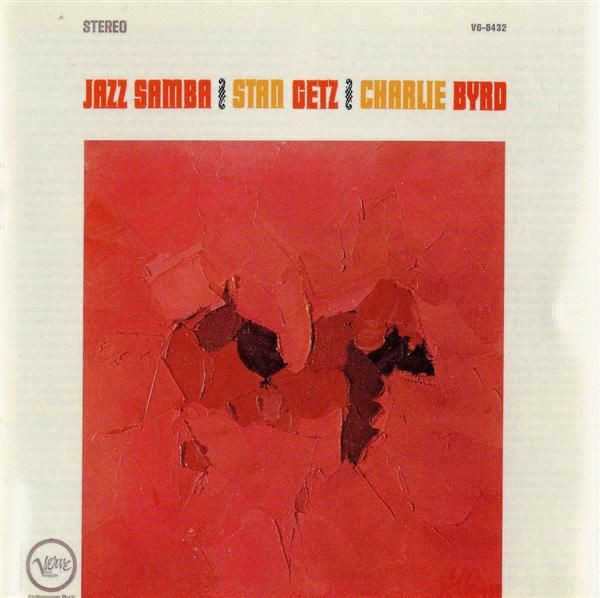
Jazz Samba
 View on Discogs
 View on Wikipedia
Album Summary
Jazz Samba was laid down in Washington D.C. in February of 1962 and released that same year on the legendary Verve Records — and honey, when this record dropped, it changed the whole conversation. Produced by the meticulous Creed Taylor, the album brought together the cool, searching tenor saxophone of Stan Getz and the warm acoustic guitar genius of Charlie Byrd, two men who understood that something extraordinary was bubbling up from Brazil. The session also featured Byrd's brother Gene on bass and drummer Buddy Dougherty, all locked into the gentle, hypnotic pulse of bossa nova. This was not a novelty act chasing a trend — this was serious musicians recognizing that Antonio Carlos Jobim and João Gilberto had created something that deserved to be heard by the whole world, and Stan Getz had the soul and the sensitivity to carry that message north.
Reception
- Jazz Samba climbed all the way to number one on the Billboard Jazz Albums chart, becoming one of the best-selling jazz albums of the entire year 1962.
- Critics fell hard for the album, celebrating Getz's luminous, lyrical tenor tone and the way the rhythm section honored the delicate swing of bossa nova without ever heavying it up.
- The album became a genuine commercial breakthrough, pulling in listeners far beyond the usual jazz audience and establishing bossa nova as a mainstream phenomenon across the United States.
Significance
- Jazz Samba served as the great introduction — the handshake between American jazz culture and authentic Brazilian bossa nova — arriving at a moment when audiences were hungry for something sophisticated yet undeniably warm.
- The album proved that cross-cultural musical collaboration, when approached with respect and deep listening, could produce something greater than either tradition alone, a lesson that echoed through decades of Latin-jazz exploration that followed.
- By wrapping the harmonic richness of cool jazz around the gentle rhythmic elegance of Brazilian popular music, Jazz Samba helped define an entire aesthetic mood for the early 1960s, one that still feels like a cool breeze off the ocean whenever the needle drops.
Samples
- Desafinado — one of the most recognized bossa nova recordings in history, widely interpolated and referenced across jazz, soul, and contemporary productions paying homage to the genre's foundation.
Tracklist
-
A1 Desafinado 141
 5:47
5:47
-
A2 Samba Dees Days —
3:30
-
A3 O Pato 90
2:35
-
A4 Samba Triste —
4:45
-
B1 Samba De Uma Nota So 76
6:07
-
B2 E Luxo So —
3:40
-
B3 Baia —
6:35

Artist Details
Stan Getz was a silky-smooth tenor saxophone genius born in Philadelphia in 1927, a cat who floated through the jazz world like warm smoke, blending cool West Coast jazz with a sound so tender and lyrical it could make the hardest heart melt clean away. He rose to international superstardom in the early 1960s when he linked up with Brazilian maestros João Gilberto and Antônio Carlos Jobim to record the landmark album *Getz/Gilberto* in 1964, essentially introducing the intoxicating sound of bossa nova to American ears and winning himself a Grammy for his trouble. Stan Getz stood as a true bridge between cultures, proving that music has no borders, and his breathy, unhurried tone on the saxophone remains one of the most instantly recognizable and deeply beloved sounds in all of jazz history.