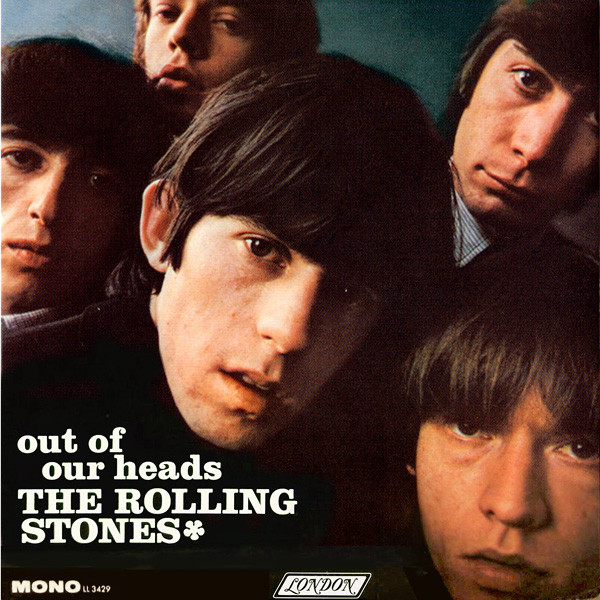
Out Of Our Heads
 View on Discogs
 View on Wikipedia
Album Summary
Out Of Our Heads came roaring out of two of the most hallowed recording spaces in American music — RCA Studios in Hollywood and the legendary Chess Studios in Chicago — and landed on the streets in July of 1965, courtesy of London Records in the States and Decca back home in the UK. The band's sharp-minded manager and producer Andrew Loog Oldham helmed the sessions, steering the Stones through a pivotal crossing point in their journey. This was the record where five young men from England — soaked in the American blues they'd been worshipping since their teenage years — began to step out of the shadow of their heroes and into a light entirely their own. The blues covers were still there, rich and reverential, but so was something new: original songs with an edge, an attitude, and a hunger that nobody else in 1965 could touch.
Reception
- Out Of Our Heads climbed to number one on the Billboard 200 in the United States, cementing the Rolling Stones as a dominant commercial force in the American market.
- The album reached number two on the UK Albums Chart, confirming the band's massive appeal on both sides of the Atlantic simultaneously.
- Critical reception celebrated the record's bold balance between faithful blues interpretation and the band's own emerging songwriting voice, with Jagger-Richards compositions drawing particular praise for their raw, rebellious energy.
Significance
- Out Of Our Heads represented the moment the Rolling Stones fully shed their identity as a covers band and announced themselves as genuine songwriters and rock architects — a shift that would reshape the direction of British rock music for years to come.
- The album stood as one of the defining statements of the British Invasion, taking the very soul of American blues and rhythm and blues and redelivering it to the world with a harder, more confrontational attitude that no one had quite heard before.
- With tracks like Satisfaction and The Last Time leading the charge, the record helped push rock music toward a more rebellious, guitar-driven aesthetic that influenced the sound and spirit of rock bands for generations after.
Samples
- Satisfaction — one of the most recognized and referenced riffs in all of popular music, the song has been sampled, interpolated, and reimagined across hip-hop, pop, and electronic music spanning multiple decades.
- Play With Fire — sampled and interpolated by various hip-hop and pop artists drawn to its stark, hypnotic arrangement and dark lyrical tone.
- The Last Time — the song's guitar figure and melodic structure have been borrowed and built upon by artists across genres, most famously interpolated in a way that sparked one of rock music's most talked-about songwriting disputes.
Tracklist
-
A1 Mercy Mercy —
 2:45
2:45
-
A2 Hitch Hike 123
2:22
-
A3 The Last Time 167
3:35
-
A4 That's How Strong My Love Is 96
2:23
-
A5 Good Times 126
1:57
-
A6 I'm All Right —
2:21
-
B1 Satisfaction —
3:45
-
B2 Cry To Me 181
3:08
-
B3 The Under Assistant West Coast Promotion Man 136
3:10
-
B4 Play With Fire 108
2:15
-
B5 The Spider And The Fly 98
3:30
-
B6 One More Try 177
1:58

Artist Details
The Rolling Stones, those bad boys out of London, England, came together in 1962 and proceeded to set the world on fire with a raw, blues-drenched rock and roll sound that made even the devil himself tap his foot — Mick Jagger's swagger, Keith Richards' riffs, and that whole crew built something dangerous and beautiful that the world wasn't quite ready for. They stood toe-to-toe with the Beatles as the defining force of the British Invasion, but where the Fab Four gave you sunshine, the Stones handed you a little darkness, a little soul, a little street — and the world ate it up like gospel. Decades deep into their run, with classics like "Paint It Black," "Gimme Shelter," and "Sympathy for the Devil" permanently etched into the fabric of rock history, the Rolling Stones remain a living, breathing monument to the power of music that refuses to be tamed.