Abraxas
 View on Discogs
 View on Wikipedia
Album Summary
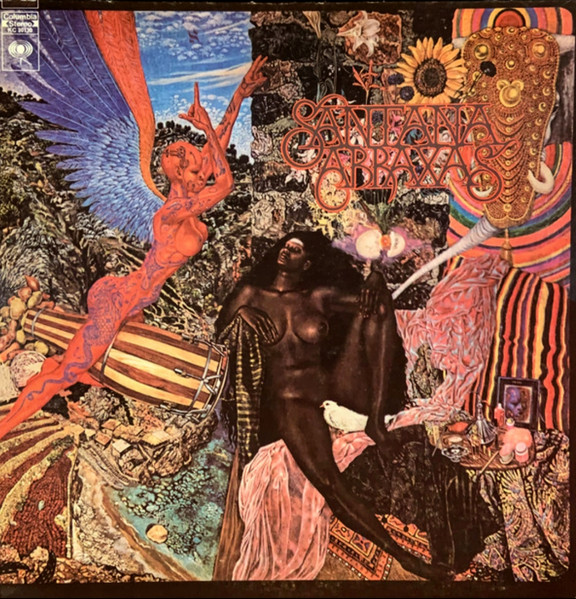
Abraxas was laid down in the studio and released in 1970 on Columbia Records, riding the wave of creative fire that followed Santana's landmark debut. Produced by the band alongside engineer Fred Catero, this record captured Carlos Santana and his crew at a moment when they were pushing deeper into territory that nobody else had the nerve or the soul to explore. The sessions took place at Columbia's studios in Los Angeles, and what came out of those rooms was something that went far beyond Latin rock — it was Afro-Cuban rhythm meeting psychedelic vision meeting blues-drenched guitar, all wrapped up in a sound that felt like it was born somewhere between San Francisco and the heart of the Caribbean.
Reception
- Abraxas climbed all the way to number one on the Billboard 200, cementing Santana's place not just as a cult favorite but as one of the most commercially powerful acts in rock music at the turn of the decade.
- Critical reception was overwhelmingly warm, with reviewers singling out the band's tightened musicianship, the lush dynamic arrangements, and the effortless way the group wove Latin percussion into the fabric of hard rock and blues without ever losing the groove.
Significance
- Abraxas stands as one of the true cornerstones of the Latin rock genre, proving with undeniable authority that percussion-driven Afro-Cuban musical traditions could live at the center of mainstream rock without sacrificing one ounce of artistic integrity.
- The album positioned Santana as pioneering architects of a fusion sound that would ripple outward through rock, pop, and hip-hop for decades to come, opening doors that had never been cracked before in popular music.
- Abraxas elevated the role of Latin percussion within rock by giving figures like Michael Carabello and keyboardist Gregg Rolie the space to shine as equals alongside Carlos Santana's iconic guitar work, reshaping expectations for what a rock band could sound like.
Samples
- "Oye Como Va" — one of the most recognized and sampled tracks in the Latin rock canon, interpolated and sampled across hip-hop, Latin pop, and dance music productions for decades following its release.
- "Black Magic Woman / Gypsy Queen" — sampled and interpolated by various hip-hop and R&B producers drawn to its hypnotic minor-key groove and atmospheric guitar tone.
- "Samba Pa Ti" — the instrumental's deeply emotive guitar melody has been sampled and referenced in soul, hip-hop, and neo-soul productions seeking that signature Santana warmth.
Tracklist
-
A1 Singing Winds, Crying Beasts 120
 4:48
4:48
-
A2 Black Magic Woman / Gypsy Queen 123
5:17
-
A3 Oye Como Va 129
4:17
-
A4 Incident At Neshabur 136
4:58
-
B1 Se A Cabo 137
2:49
-
B2 Mother's Daughter 138
4:25
-
B3 Samba Pa Ti 92
4:46
-
B4 Hope You're Feeling Better 93
4:10
-
B5 El Nicoya 146
1:29

Artist Details
Santana is a rock band formed in San Francisco, California in 1966, led by Mexican-American guitarist Carlos Santana, who immigrated from Autlán de Navarro, Mexico. The group pioneered a distinctive sound that fused rock, blues, and jazz with Afro-Cuban and Latin rhythms, creating a genre-blending style that set them apart from virtually every other act of their era. Their legendary performance at the 1969 Woodstock Festival introduced them to a massive worldwide audience, and their debut album released that same year became a commercial and critical success. Santana experienced a major commercial resurgence in 1999 with the album Supernatural, which won nine Grammy Awards including Album of the Year and became one of the best-selling albums in history. Culturally, Santana holds profound significance as a symbol of Latin musical influence in mainstream American rock, helping to bridge cultures and pave the way for broader acceptance of Latin artists in the global music industry.