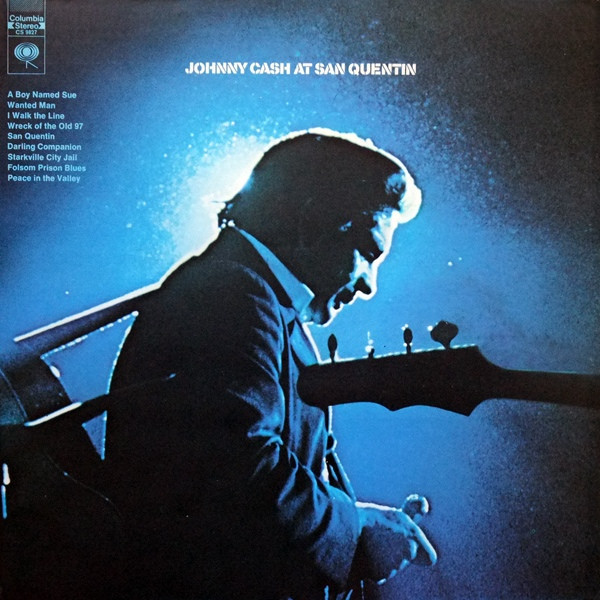
Johnny Cash At San Quentin
 View on Discogs
 View on Wikipedia
Album Summary
Recorded live on February 24, 1969, at San Quentin State Prison in California before a captive audience of inmates — and brother, when they say captive, they mean it — 'Johnny Cash At San Quentin' was released by Columbia Records later that year. The concert was produced by the legendary Bob Johnston, the same cat who had been behind the glass for Bob Dylan, and the whole electric evening was filmed for a Granada Television documentary. Cash brought his full road family with him — the Tennessee Three, the incomparable June Carter Cash, and the one and only Carl Perkins — and together they delivered a performance so raw, so alive, so absolutely on fire that the walls of that prison couldn't contain it. This was Johnny Cash not on a stage for the comfortable and the clean, but standing face to face with men the world had turned its back on, and giving them every ounce of himself.
Reception
- The album shot straight to number one on both the Billboard pop albums chart and the country albums chart, standing tall as one of the greatest commercial triumphs of Cash's entire career.
- The single 'A Boy Named Sue,' a Shel Silverstein composition that made its world debut right there at San Quentin, became a runaway smash — climbing to number two on the Billboard Hot 100 and earning Cash a Grammy Award for Best Male Country Vocal Performance.
- Critics fell hard for the album's visceral, unvarnished energy and the unmistakable rapport Cash had with that prison audience, deepening his standing as the one true voice for the forgotten and the locked away.
Significance
- 'Johnny Cash At San Quentin' stands as a towering landmark in both live recording history and the outlaw country tradition, capturing something that no studio session could ever manufacture — a genuine, bone-deep communion between an artist and an audience of convicted men at one of the most turbulent moments in American history.
- Cash's defiant, soul-shaking performance of 'San Quentin' — which he performed twice after the inmates demanded it with a ferocity that rattled the room — became one of the most iconic moments in live music history, a bold act of solidarity with prisoners and a direct challenge to the American penal system.
- The album cemented Cash's enduring identity as a rebel, a humanitarian, and a truth-teller, casting a long shadow over generations of country, rock, and Americana artists who looked to him as proof that music could be a weapon against indifference and injustice.
Samples
- A Boy Named Sue — sampled by numerous hip-hop and rap artists across decades, with the track's spoken-word cadence and narrative structure making it one of the more referenced Cash recordings in sample culture.
Tracklist
-
A1 Wanted Man 91
 4:02
4:02
-
A2 Wreck Of The Old 97 117
3:19
-
A3 I Walk The Line 98
2:14
-
A4 Darling Companion —
7:08
-
A5 Starkville City Jail —
2:06
-
B1 San Quentin 83
4:08
-
B2 San Quentin 83
3:05
-
B3 A Boy Named Sue 103
3:50
-
B4 (There'll Be) Peace In The Valley 84
2:37
-
B5 Folsom Prison Blues 110
1:32

Artist Details
Johnny Cash was a towering figure out of Kingsland, Arkansas, who emerged in the mid-1950s on the Sun Records label alongside legends like Elvis and Jerry Lee Lewis, blending country, rockabilly, blues, and gospel into a sound so raw and honest it felt like it came straight from the American soul. His deep, resonant voice and outlaw spirit — captured in anthems like "Folsom Prison Blues" and "Ring of Fire" — made him the voice of the working class, the downtrodden, and the forgotten, earning him a place in not one but four music halls of fame. From the cotton fields of Arkansas to sold-out prison concerts to his legendary late-career comeback with the American Recordings series, Johnny Cash wasn't just a musician — he was the conscience of American music itself.