Blows Against The Empire
 View on Discogs
 View on Wikipedia
Album Summary
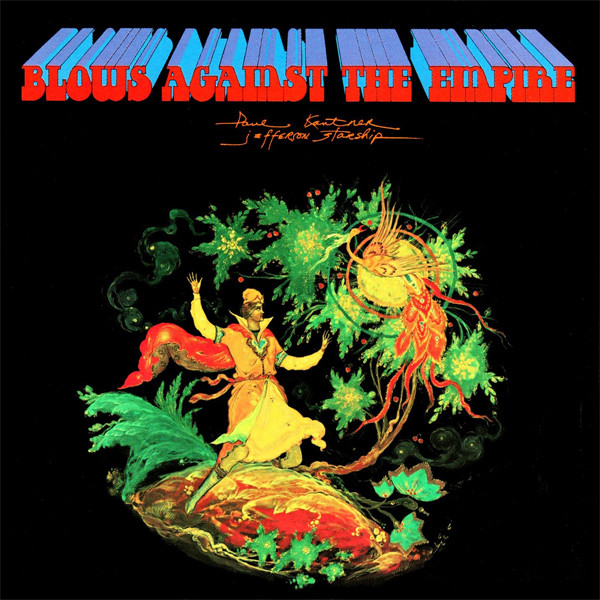
Blows Against the Empire came rolling out of the San Francisco Bay Area in 1970 on RCA Victor, produced by Paul Kantner and David Crosby, and baby, it was unlike anything that had come before it. Credited to Paul Kantner and Jefferson Starship — the very first time that name ever graced a record label — this was a sprawling, visionary science fiction concept album built from the collective energy of the West Coast's finest souls. Grace Slick, David Crosby, Graham Nash, Jerry Garcia, Mickey Hart, and a whole constellation of counterculture luminaries came together in that beautiful, communal San Francisco spirit to help Kantner paint his cosmic picture. This was not just a rock record. This was a manifesto pressed into vinyl.
Reception
- The album earned a nomination for the Hugo Award for Best Dramatic Presentation in 1971, one of the most extraordinary moments of crossover recognition in rock history, acknowledged by the science fiction literary community as a legitimate work of speculative art.
- Critics of the era received it warmly, praising its ambitious conceptual sweep and the lush, warm textures of its communal sound, though some noted that its sprawling utopian narrative favored idealism over tight structural cohesion.
- The album reached number 22 on the Billboard 200, a genuinely respectable chart showing for a record this dense, this experimental, and this uncompromisingly visionary in its ambitions.
Significance
- Blows Against the Empire stands as one of rock music's earliest full-length concept albums built explicitly around a science fiction narrative, chronicling a band of counterculture radicals who hijack a starship to flee a corrupt and dying Earth — a story that felt as urgent then as it sounds legendary now.
- The record is a time capsule of the highest order, capturing the late hippie counterculture at its most cosmic and communal, wrapping themes of rebellion against authoritarianism, collective living, and utopian freedom in the grandest, most starward-reaching musical language the era had to offer.
- This album planted the flag for the Jefferson Starship name and identity, setting in motion one of rock's most enduring band legacies while simultaneously standing as the fullest expression of the Haight-Ashbury collaborative spirit that defined a generation.
Tracklist
-
A1 Mau Mau (Amerikon) 137
 6:33
6:33
-
A2 The Baby Tree 90
1:42
-
A3 Let's Go Together 97
4:11
-
A4 A Child Is Coming 148
6:15
-
B1 Sunrise 87
1:54
-
B2 Hijack 99
8:18
-
B3 Home 77
0:37
-
B4 Have You Seen The Stars Tonite 92
3:42
-
B5 X M 130
1:22
-
B6 Starship 101
7:07

Artist Details
Paul Kantner was a founding member of the legendary San Francisco psychedelic rock band Jefferson Airplane, one of the most groundbreaking groups to rise out of the Haight-Ashbury scene in the mid-1960s, bringing that cosmic, free-spirited sound that defined an entire generation's hunger for something deeper and more alive. As a guitarist, vocalist, and visionary songwriter, Kantner helped shape the countercultural soundtrack of the late '60s and early '70s, and later formed Jefferson Starship, keeping that exploratory spirit burning well into the next decade. His work wasn't just music — it was a statement, a philosophy, a call to the wandering souls who believed that rock and roll could change the world.