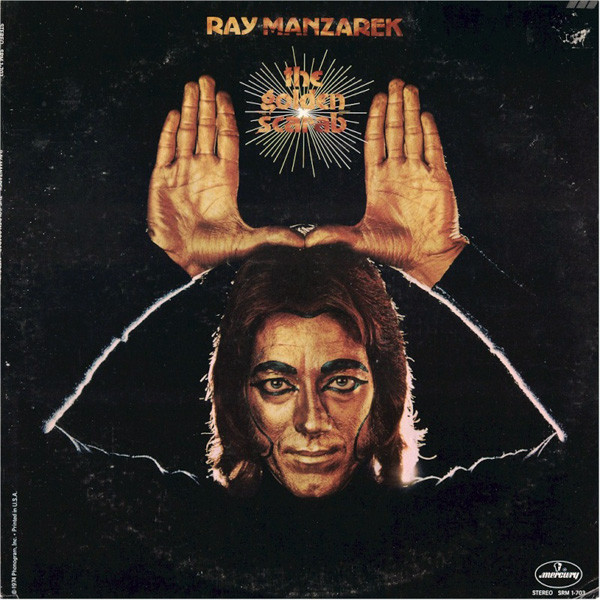
The Golden Scarab
 View on Discogs
 View on Wikipedia
Album Summary
Ray Manzarek, the keyboard wizard and one of the founding architects of The Doors, stepped out on his own in 1974 and delivered 'The Golden Scarab' through Mercury Records — and baby, this was no ordinary solo debut. Produced by Larry Cansler, this record found Manzarek deep in a mystical, spiritually charged headspace, weaving together his classical training, rock instincts, and a fascination with ancient Egyptian mythology and Eastern philosophy into something that felt like a séance and a rock concert happening at the same time. Recorded in the early seventies milieu of Los Angeles, where cosmic consciousness was practically in the air, Manzarek assembled a crew of musicians and let his keyboards do what they always did — carry the whole universe on their shoulders.
Reception
- The album was met with a modest commercial response upon release, finding its audience primarily among devoted fans of Manzarek's previous work and listeners drawn to its esoteric, progressive rock sensibility rather than mainstream radio.
- Critical reception recognized the album's ambitious conceptual sweep and Manzarek's keyboard virtuosity, though some reviewers found its mystical themes and sprawling structures more challenging than accessible.
- The record did not produce a significant charting single, remaining more of a cult artifact appreciated by those who sought it out rather than a mainstream breakthrough.
Significance
- 'The Golden Scarab' stands as a bold early example of a rock keyboardist pushing into concept album territory rooted in ancient mythology and spiritual philosophy, bridging psychedelic rock with the progressive ambitions that defined the mid-seventies.
- Tracks like 'Solar Boat' and 'The Golden Scarab' reflect a genuine scholarly reverence for Egyptian cosmology, making this one of the more intellectually earnest explorations of ancient symbolism in rock music of the era.
- The album demonstrated that Manzarek's musical identity was inseparable from literary and philosophical depth, reinforcing his reputation as one of rock's most cerebral and soulful instrumentalists working in the post-psychedelic landscape.
Tracklist
-
A1 He Can't Come Today 119
 4:35
4:35
-
A2 Solar Boat 117
5:15
-
A3 Downbound Train 144
5:27
-
A4 The Golden Scarab 123
6:42
-
B1 The Purpose Of Existence Is? —
6:42
-
B2 The Moorish Idle —
5:40
-
B3 Choose Up And Choose Off —
4:42
-
B4 Oh Thou Precious Nectar Filled Form (Or) A Little Fart 125
4:58

Artist Details
Ray Manzarek was the classically trained keyboard wizard who helped birth one of rock and roll's most mystical and hypnotic sounds as the co-founder of The Doors, rising up out of Los Angeles in 1965 alongside the legendary Jim Morrison. His left hand played the bass lines on a Fender Rhodes keyboard bass while his right hand wove those dark, haunting organ melodies, essentially doing the work of two musicians and giving The Doors their unmistakable sound that blended psychedelic rock, blues, and poetic soul unlike anything the world had heard before. Even after Morrison's passing in 1971, Manzarek carried the flame of that era's spirit forward, reminding the world that the music of The Doors wasn't just songs — it was a whole philosophy, a whole way of seeing life.