Emerson, Lake & Palmer
 View on Discogs
 View on Wikipedia
Album Summary
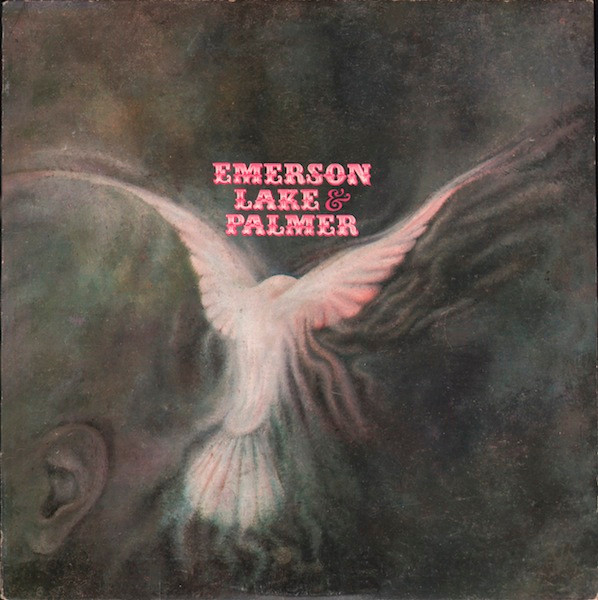
Emerson, Lake & Palmer's self-titled debut came roaring out of the gate in 1970 on Island Records, and honey, when this record dropped, the whole music world stopped and listened. Produced by the band themselves — three cats who already had serious pedigree before they ever walked into the same room together — the album brought together keyboardist Keith Emerson fresh from The Nice, the silky-voiced bassist and vocalist Greg Lake out of King Crimson, and the thunderous Carl Palmer, who'd been laying it down with Atomic Rooster. They recorded this thing with the confidence of men who knew exactly what they were building, and what they were building was something nobody had ever quite heard before. This was a supergroup that actually lived up to the name.
Reception
- The album reached #4 on the UK Albums Chart and #18 on the US Billboard 200, earning gold certification in multiple countries and proving that ambitious, classically-influenced rock could move serious units.
- Critics came out swinging with praise for the band's staggering technical virtuosity and their fearless approach to weaving classical compositions into a hard rock framework.
- The debut was widely regarded as an immediate and undeniable statement of intent, planting ELP's flag firmly at the forefront of the emerging progressive rock movement from the very first spin.
Significance
- This record became an instant cornerstone of progressive rock, demonstrating that the electric keyboard could reign as a lead instrument with the same authority and fire as any guitar — and Keith Emerson made sure the whole world knew it on tracks like 'The Barbarian' and 'Knife-Edge'.
- By boldly adapting classical compositions and fusing them with rock energy, ELP's debut helped forge the blueprint for art rock and opened the door for a generation of musicians who dared to think bigger and stranger.
- The album's success sent a signal across the industry that audiences were hungry for complexity and ambition, directly influencing the direction progressive rock would travel throughout the early 1970s and inspiring countless bands to push past the boundaries of conventional song structure.
Samples
- Lucky Man — the lush Moog synthesizer outro became one of the most recognizable synthesizer moments in rock history and has been sampled and interpolated across multiple genres, with the track's dreamy sonic texture drawing particular attention from hip-hop and electronic producers over the decades.
Tracklist
-
A1 The Barbarian —
 4:27
4:27
-
A2 Take A Pebble —
12:32
-
A3 Knife-Edge —
5:04
-
B2 Tank 169
6:49
-
B3 Lucky Man —
4:36

Artist Details
Emerson, Lake & Palmer — or ELP as the cats in the know called them — came together in England in 1970, a supergroup born from the collision of three virtuosos: keyboard wizard Keith Emerson, the velvet-voiced bassist and guitarist Greg Lake, and the thunderous percussionist Carl Palmer, who together forged a sound that married classical music with hard rock in a way that made the whole world sit up straight. They were the architects of progressive rock at its most ambitious and bombastic, filling concert halls with Moog synthesizers, orchestras, and enough musical complexity to make your head spin in the most beautiful way. Their cultural significance lies in how they dared to treat rock music as serious art, pushing the boundaries of what a three-piece band could achieve and leaving a legacy that still echoes through every prog rock musician who picked up an instrument and dared to dream bigger.