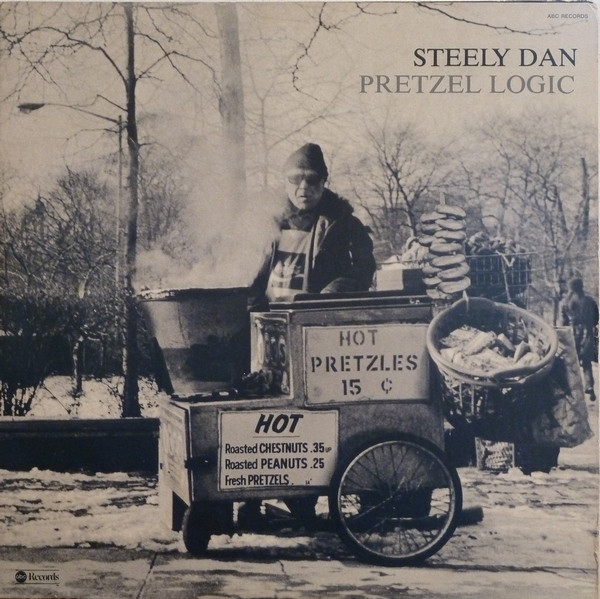
Pretzel Logic
 View on Discogs
 View on Wikipedia
Album Summary
Pretzel Logic came together in 1974, laid down with the kind of careful, deliberate artistry that was already becoming the Steely Dan trademark. Released on ABC Records, this was the third studio album from the duo of Donald Fagen and Walter Becker, produced once again by the indispensable Gary Katz — the man who helped translate their restless, jazz-soaked vision into something that could knock you sideways on a Tuesday afternoon. By this point, Fagen and Becker had begun leaning heavily on seasoned session musicians rather than a fixed touring band, and that creative pivot gave Pretzel Logic a suppleness and precision that set it apart from nearly everything else on the radio in 1974.
Reception
- Pretzel Logic climbed to number eight on the Billboard 200, marking Steely Dan's breakthrough moment with mainstream American audiences and proving that sophisticated could still mean successful.
- The album's lead single, Rikki Don't Lose That Number, cracked the top ten and became one of the most beloved tracks in the band's entire catalog — a song that radio programmers and listeners alike simply could not put down.
- The album earned platinum certification, cementing Steely Dan's standing as both a critical darling and a genuine commercial force in 1970s popular music.
Significance
- Pretzel Logic stands as a landmark in the marriage of jazz harmony, R&B rhythm, and rock sensibility — a record that refused to be pinned down by genre and was all the richer for it, full of the kind of harmonic sophistication and lyrical wit that demanded repeated listening.
- The album reinforced Steely Dan's growing reputation as studio perfectionists, artists who treated the recording process itself as a compositional tool, and whose meticulous approach would raise the bar for pop and rock production throughout the decade.
- With tracks ranging from the sly cool of Rikki Don't Lose That Number to the Duke Ellington-nodding East St. Louis Toodle-oo, Pretzel Logic demonstrated a rare breadth of musical reference that placed Fagen and Becker in a category entirely their own among their contemporaries.
Samples
- Rikki Don't Lose That Number — one of the most recognized Steely Dan tracks in sampling culture, drawn upon by various hip-hop and R&B producers across multiple decades for its melodic bass line and harmonic sophistication.
- Parker's Band — sampled and referenced by hip-hop producers attracted to its hard-swinging rhythmic feel and jazz-inflected horn and keyboard textures.
- Monkey In Your Soul — tapped by producers for its funky, loose-limbed groove, a track that carries a rhythmic warmth that translates well into sample-based music.
Tracklist
-
A1 Rikki Don't Lose That Number 117
 4:30
4:30
-
A2 Night By Night 161
3:36
-
A3 Any Major Dude Will Tell You 80
3:05
-
A4 Barrytown 129
3:17
-
A5 East St. Louis Toodle-oo —
2:45
-
B1 Parker's Band 139
2:36
-
B2 Through With Buzz 136
1:30
-
B3 Pretzel Logic 72
4:28
-
B4 With A Gun 108
2:15
-
B5 Charlie Freak 131
2:41
-
B6 Monkey In Your Soul 117
2:31

Artist Details
Steely Dan is the brainchild of the two cats who started it all — Walter Becker and Donald Fagen — who came together in New York in the early 1970s and proceeded to cook up one of the most sophisticated, jazz-tinged rock sounds anybody had ever heard, blending studio perfection with cryptic, cynical lyrics that made you feel like you were in on some private joke about the absurdity of American life. From Reelin' in the Years to Aja, these gentlemen turned the recording studio itself into an instrument, setting a standard for musical craftsmanship that left the whole industry shaking its head in admiration. Their influence runs so deep that decades after their heyday, producers and musicians are still chasing that Steely Dan sound — that gorgeous, elusive blend of cool detachment and deeply felt groove that nobody else has ever quite managed to capture.