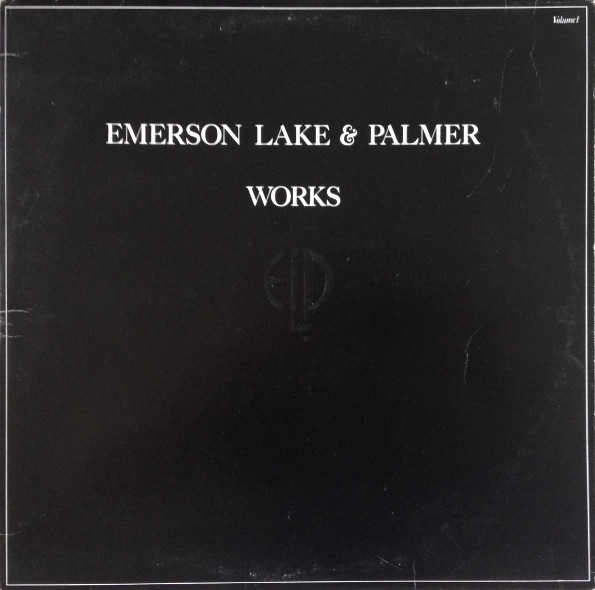
Works (Volume 1)
 View on Discogs
Album Summary
Works (Volume 1) came into the world in 1977 on Atlantic Records, a sprawling double album that showed Emerson, Lake & Palmer reaching deeper into their classical ambitions than ever before. Each member took a side of this four-sided opus as his own canvas — Keith Emerson delivered his Piano Concerto No. 1 with full orchestral backing, Greg Lake offered an intimate, acoustic-leaning side of his own songwriting soul, and Carl Palmer stretched out with his percussive vision. The whole magnificent undertaking was produced by the band themselves alongside Greg Lake, with orchestral arrangements that demanded nothing less than a full symphony orchestra to bring to life. This was progressive rock not just flirting with the classical tradition — this was a full, committed embrace, released at a moment when the music world was shifting fast and ELP refused to blink.
Reception
- The album reached the top 10 in the UK charts and earned gold certification, proving that a significant audience was still hungry for the band's grand orchestral vision even as punk rock was shaking the foundations of the music industry.
- Critical reception landed on both sides of the fence — admirers celebrated the sheer ambition and technical mastery on display, while detractors felt the album stretched its reach beyond its grasp, veering into territory some called overblown and self-indulgent.
Significance
- Works (Volume 1) stands as one of the most ambitious statements of progressive rock's classical crossover movement, weaving full orchestral arrangements together with virtuosic rock instrumentation in a way that few bands before or since have attempted on such a scale.
- The album captures the maximalist spirit of 1970s progressive rock at its most unapologetic peak — extended compositions, complex time signatures, and performances from Emerson, Lake, and Palmer that represent each man operating at the absolute height of his individual artistry.
- Tracks like Fanfare For The Common Man and Pirates cemented the album's place in the prog-rock canon, with the former's thunderous reimagining of Aaron Copland's orchestral classic becoming one of the defining rock moments of the entire decade.
Samples
- Fanfare For The Common Man — one of the most recognizable reinterpretations in rock history, this track has been sampled and interpolated across multiple genres, carrying its massive, iconic brass-and-drum signature into hip-hop and electronic productions over the decades.
Tracklist
-
B1 Lend Your Love To Me Tonight —
 4:00
4:00
-
B2 C'est La Vie —
4:17
-
B3 Hallowed Be Thy Name —
4:35
-
B4 Nobody Loves You Like I Do —
3:56
-
B5 Closer To Believing —
5:34
-
C1 The Enemy God Dances With The Black Spirits (Excerpt From "The Scythian Suite") —
3:16
-
C2 L.A.Nights —
5:42
-
C3 New Orleans 143
2:45
-
C4 Two Part Invention In D Minor 96
1:53
-
C5 Food For Your Soul 106
3:58
-
C6 Tank 169
5:09
-
D1 Fanfare For The Common Man 72
9:38
-
D2 Pirates 97
13:20

Artist Details
Emerson, Lake & Palmer — or ELP as the cats in the know called them — came together in England in 1970, a supergroup born from the collision of three virtuosos: keyboard wizard Keith Emerson, the velvet-voiced bassist and guitarist Greg Lake, and the thunderous percussionist Carl Palmer, who together forged a sound that married classical music with hard rock in a way that made the whole world sit up straight. They were the architects of progressive rock at its most ambitious and bombastic, filling concert halls with Moog synthesizers, orchestras, and enough musical complexity to make your head spin in the most beautiful way. Their cultural significance lies in how they dared to treat rock music as serious art, pushing the boundaries of what a three-piece band could achieve and leaving a legacy that still echoes through every prog rock musician who picked up an instrument and dared to dream bigger.