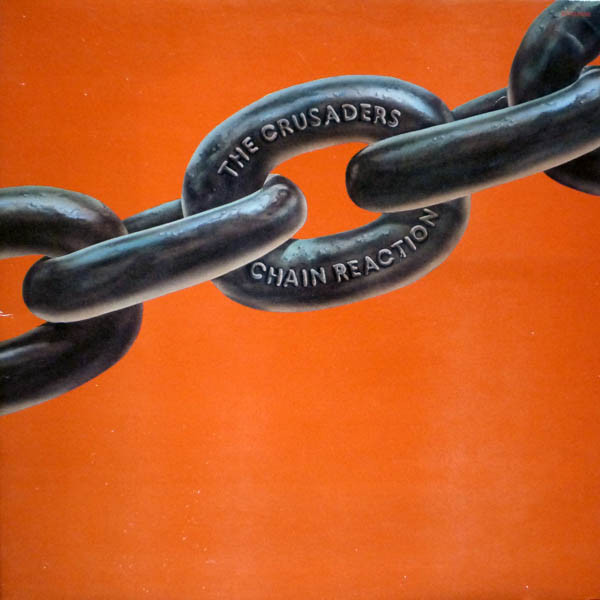
Chain Reaction
 View on Discogs
 View on Wikipedia
Album Summary
Chain Reaction came together in 1975, released on the ABC Blue Thumb label — a time when The Crusaders were absolutely on fire, riding a creative wave that had been building since they dropped the 'Jazz' from their name and let the funk breathe a little deeper into everything they touched. Produced by the band themselves alongside Stewart Levine, their trusted collaborator who understood exactly what these cats were going for, the album showcased the core unit of Wilton Felder on tenor saxophone, Joe Sample on keyboards, Stix Hooper on drums, and Wayne Henderson on trombone — four musicians who had been playing together since their Houston days and could communicate without saying a word. The result was a record that felt both effortlessly cool and deliberately crafted, a testament to what happens when seasoned professionals are given the space to do what they do best.
Reception
- Chain Reaction performed solidly on both the jazz and R&B charts, confirming that The Crusaders had built a loyal audience that stretched well beyond the boundaries of any single genre.
- Critics recognized the album as a strong entry in the Crusaders' catalog, praising the band's ability to maintain musical sophistication while delivering grooves with genuine commercial appeal.
- The album reinforced the Crusaders' standing as one of the most consistent and respected acts in the jazz-funk space during the mid-1970s.
Significance
- Chain Reaction stands as a defining document of 1970s jazz-funk fusion, capturing the moment when jazz musicians were reclaiming the dancefloor without sacrificing a single ounce of musicianship or soul.
- The album reflects the Crusaders' singular gift for blending sophisticated jazz harmony and improvisation with the deep, irresistible pull of funk rhythm — a balance that very few acts of any era have managed to strike so naturally.
- Recorded at a time when jazz-funk was beginning to find serious mainstream radio traction, Chain Reaction helped legitimize the genre as something that could move both the mind and the body simultaneously.
Samples
- Give It Up — sampled by various hip-hop and soul producers drawn to its deep funk pocket and rhythmic foundation, making it one of the more revisited cuts from this album in sample-based music.
- Chain Reaction — the title track has been pulled into the crates by producers seeking that quintessential mid-seventies jazz-funk tension and release.
- Creole — its opening groove has attracted the attention of hip-hop producers looking for authentic instrumental foundation with genuine jazz credibility.
Tracklist
-
A1 Creole 172
 3:25
3:25
-
A2 Chain Reaction 99
5:35
-
A3 I Felt The Love 107
2:28
-
A4 Mellow Out 127
2:44
-
A5 Rainbow Visions 76
6:15
-
B1 Hallucinate 95
5:08
-
B2 Give It Up 105
2:56
-
B3 Hot's It 107
3:50
-
B4 Sugar Cane 103
2:31
-
B5 Soul Caravan 104
5:30

Artist Details
The Crusaders — originally known as the Jazz Crusaders — came together in Houston, Texas in the late 1950s, a band of brothers forged in the church and the streets, blending hard bop jazz with blues, funk, and soul into something so deep and righteous it had no choice but to become its own thing. With cats like Joe Sample on keys, Wilton Felder on saxophone, and Stix Hooper holding down the pocket on drums, they became one of the defining forces in the development of soul-jazz and funk, laying the groundwork for what folks would later call smooth jazz while always keeping that raw, earthy feeling underneath. Their 1979 smash "Street Life," featuring the incomparable Randy Crawford on vocals, brought them to the mainstream masses, but true music lovers knew long before that these cats were the real deal — session players, bandleaders, and sonic architects who shaped the sound of an era.