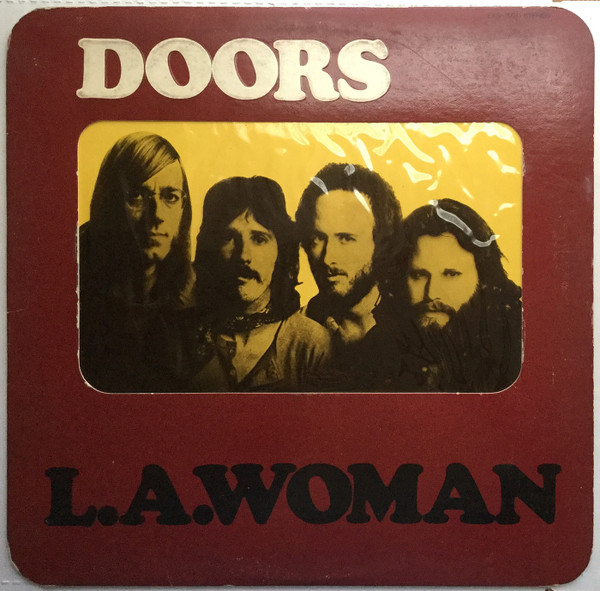
L.A. Woman
 View on Discogs
 View on Wikipedia
Album Summary
L.A. Woman was laid down in the most organic way The Doors ever recorded — right there in their own rehearsal space on Santa Monica Boulevard, Los Angeles, with the band setting up like they were playing a club gig. Elektra Records put it out in April of 1971, and the whole thing was self-produced by the band alongside their trusted engineer Bruce Botnick, after original producer Paul Rothchild walked away saying the sessions sounded like 'cocktail music.' Well, Paul, the world begged to differ. Jim Morrison, leather-voiced and road-worn, poured everything he had left into these tracks — and nobody knew at the time that this would be the last studio album featuring his voice. By July of that same year, Morrison was gone, passed away in Paris at just twenty-seven years old, leaving L.A. Woman as his farewell letter to the city, the music, and the world.
Reception
- L.A. Woman climbed to number 9 on the Billboard 200, proving that The Doors still had commercial fire in them right up to the very end.
- Critical reception was a mixed bag when it first hit the shelves in 1971, but time has been extraordinarily kind to this record — it is now widely regarded as one of the finest albums in The Doors' entire catalog.
- The album went on to earn multi-platinum certification in the United States, a testament to its staying power across generations of listeners.
Significance
- L.A. Woman represented a bold, soulful pivot away from the baroque rock textures of the band's earlier work, diving deep into the muddy waters of blues-rock and funk — a raw, stripped-down sound that felt like the streets of Los Angeles breathing through the speakers.
- The album captured something rare and precious: the live, in-the-room energy of four musicians who had grown into each other over years of touring and recording, with extended improvisations on tracks like 'Riders On The Storm' and the epic title track showcasing a band at the absolute peak of its collective power.
- Morrison's lyrical vision on this record — steeped in American mythology, highway imagery, and the dark romance of Los Angeles — stands as some of the most evocative poetry he ever committed to tape, cementing L.A. Woman as a cornerstone of early 1970s rock and a profound statement on American cultural identity.
Samples
- "Riders On The Storm" — one of the most recognized samples in popular music, its haunting piano and rain ambiance have been lifted and interpolated across hip-hop and electronic music for decades, with notable use by Snoop Dogg in 'Riders On The Storm' (2001), a full reimagining featuring the original track.
- "L.A. Woman" — the title track's groove and Morrison's iconic vocal phrasing have been sampled and referenced widely across hip-hop and rock, making it one of the most culturally recycled moments in the Doors' entire discography.
Tracklist
-
A1 The Changeling 118
 4:20
4:20
-
A2 Love Her Madly 147
3:18
-
A3 Been Down So Long 122
4:40
-
A4 Cars Hiss By My Window 71
4:10
-
A5 L.A. Woman 170
7:49
-
B1 L'America 132
4:35
-
B2 Hyacinth House 172
3:10
-
B3 Crawling King Snake 80
4:57
-
B4 The WASP (Texas Radio And The Big Beat) 119
4:12
-
B5 Riders On The Storm 99
7:14

Artist Details
The Doors were a blazing, hypnotic rock outfit that rose out of Los Angeles, California in 1965, weaving together blues, psychedelia, and a dark poetic soul unlike anything else coming out of that era. Led by the magnetic and unpredictable Jim Morrison alongside keyboardist Ray Manzarek, guitarist Robby Krieger, and drummer John Densmore, they conjured a sound that felt like midnight on the Sunset Strip — mysterious, dangerous, and deeply alive. Their records, from "Light My Fire" to the epic sprawl of "The End," didn't just shape the counterculture of the late '60s; they permanently etched themselves into the DNA of rock and roll, making The Doors one of the most influential and enduring bands this world has ever known.