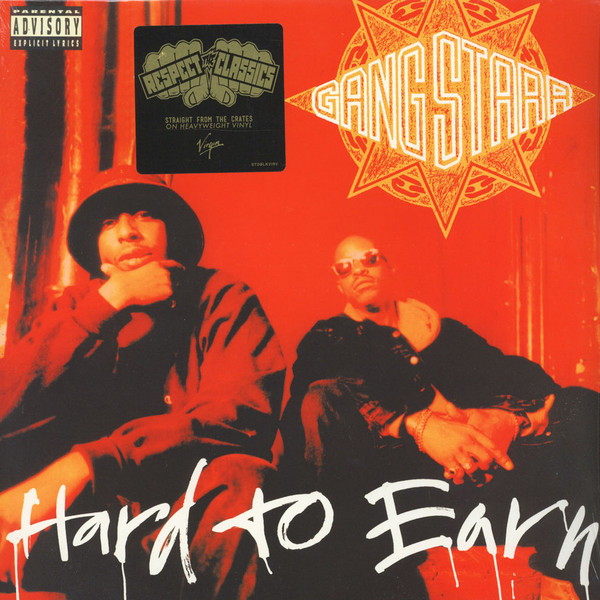
Hard To Earn
 View on Discogs
 View on Wikipedia
Album Summary
Hard to Earn came rolling out in 1994 on Chrysalis Records, and baby, it hit the streets like a freight train with something to prove. This was Gang Starr's fourth studio album, and by this point, Guru and DJ Premier had forged something so tight, so locked-in, that the whole East Coast hip-hop world was taking notes. Premier was behind the boards for the overwhelming majority of this record, laying down those signature choppy scratches, those dusty jazz-laced loops, and that unmistakable boom-bap thunder that made you feel every single bar Guru was spitting. Recorded right in the thick of hip-hop's golden age, Hard to Earn was not a record that chased trends — it set them, standing tall as a monument to craft, discipline, and the raw, uncut New York underground spirit.
Reception
- Hard to Earn debuted at number 26 on the Billboard 200, a remarkable showing for a record rooted so deeply in underground hip-hop principles, proving that substance and street credibility could coexist with genuine commercial reach in 1994.
- The album earned widespread critical praise from hip-hop publications and tastemakers who recognized DJ Premier's production and Guru's measured, authoritative lyricism as operating at the absolute peak of the art form.
- Tracks like Mass Appeal and Code of the Streets crossed over into heavy radio and MTV rotation, bringing Gang Starr's uncompromising sound to audiences far beyond the underground faithful.
Significance
- Hard to Earn stands as one of the defining statements of mid-1990s East Coast boom-bap, with DJ Premier's architecture of chopped jazz samples and razor-sharp scratches becoming a sonic blueprint that producers have been studying and chasing ever since.
- The album cemented Gang Starr's identity as true architects of socially conscious, street-level hip-hop — Guru's unflinching voice on tracks like Code of the Streets and Mass Appeal carried the weight of real experience, not performance.
- Hard to Earn proved that underground hip-hop aesthetics did not require commercial compromise to achieve meaningful impact, laying philosophical and artistic groundwork for generations of independent-minded MCs and producers who followed.
Samples
- Mass Appeal — one of the most revisited Gang Starr tracks in sampling culture, drawn upon by numerous producers across subsequent decades of hip-hop production.
- Code of the Streets — sampled and interpolated by later artists, its brooding Premier-crafted loop proving irresistible to producers mining the golden era catalog.
- The Planet — carried forward through sampling by artists who recognized the hypnotic weight of its construction, contributing to the broader legacy of Premier-produced records as source material.
- DWYCK — a celebrated collaboration with Nice and Smooth whose sonic elements have been revisited by later hip-hop producers honoring the golden era tradition.
Tracklist
-
A1 Intro (The First Step) 148
 0:54
0:54
-
A2 ALONGWAYTOGO 91
4:13
-
A3 Code Of The Streets 193
3:29
-
A4 Brainstorm 99
3:02
-
A5 Tonz 'O' Gunz 96
3:55
-
B1 The Planet 167
5:16
-
B2 Aiiight Chill... —
3:13
-
B3 Speak Ya Clout 94
3:35
-
B4 DWYCK 99
4:03
-
C1 Words From The Nutcracker 91
1:29
-
C2 Mass Appeal 96
3:41
-
C3 Blowin' Up The Spot 93
3:10
-
C4 Suckas Need Bodyguards 92
4:05
-
D1 Now You're Mine 98
2:55
-
D2 Mostly Tha Voice 91
3:38
-
D3 F.A.L.A. 92
3:10
-
D4 Comin' For Datazz 100
4:02

Artist Details
Gang Starr was a legendary hip-hop duo out of Boston and Brooklyn, formed in the late 1980s, consisting of the silky-smooth MC Guru and the jazz-soaked production genius DJ Premier, and together they cooked up something truly special — a sound that married the cool sophistication of jazz with the gritty realism of street rap. Their classic albums like Step in the Arena and Hard to Earn set the gold standard for East Coast hip-hop, and DJ Premier's chopped-up jazz samples and razor-sharp beats became the blueprint that producers would chase for decades to come. Gang Starr stands as one of the most influential acts in hip-hop history, and their legacy only grew deeper after the heartbreaking passing of Guru in 2010, cementing their place as true architects of the art form.