Pictures At An Exhibition
 View on Discogs
Album Summary
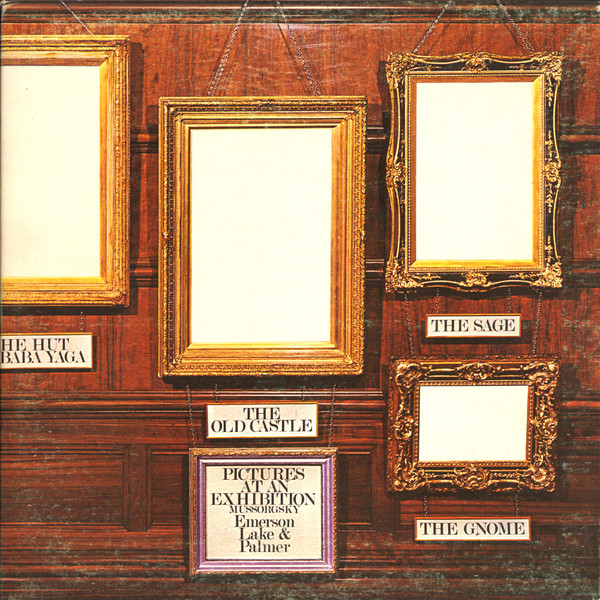
Pictures at an Exhibition was laid down live at Newcastle City Hall on March 26, 1971, capturing Emerson, Lake & Palmer in full flight before a roaring crowd that knew they were witnessing something special. Released by Atlantic/Manticore Records in November of that year, this record stands as one of the most audacious moves in the history of rock and roll — three cats taking Modest Mussorgsky's 1874 classical piano suite and turning it inside out with rock instrumentation, original compositions woven into the fabric, and improvisations that made grown musicians put down their instruments and just listen. ELP produced the album themselves, trusting their own vision to carry this ambitious marriage of the concert hall and the rock stage all the way home, and brother, it did just that.
Reception
- The album ascended to number 3 on the UK Albums Chart, proving that progressive rock audiences were hungry for something that demanded more than three minutes of their time.
- Across the Atlantic, Pictures at an Exhibition reached number 11 on the US Billboard 200, a remarkable achievement for a record rooted in 19th century classical composition.
- Critical reception greeted the album with widespread praise, with reviewers singling out the technical brilliance and the sheer nerve it took to reimagine Mussorgsky for a rock trio without flinching.
Significance
- Pictures at an Exhibition became a cornerstone of the progressive rock canon, standing as living proof that rock musicians could step into the classical world, treat it with reverence and raw power simultaneously, and walk out the other side with something entirely their own.
- Keith Emerson's commanding performance across multiple keyboards and synthesizers throughout this record helped elevate the keyboard to lead instrument status in rock music, inspiring a whole generation of players who heard this album and felt the ground shift beneath their feet.
- By fusing the structured grandeur of Mussorgsky's suite with the freedom and fire of rock improvisation — heard vividly in tracks like Blues Variation and The Great Gates Of Kiev — ELP laid down the blueprint for symphonic and classical-rock fusion that would resonate through the entire decade and well beyond.
Tracklist
-
A1 Promenade —

-
A2 The Gnome —
-
A3 Promenade —
-
A4 The Sage —
-
A5 The Old Castle —
-
A6 Blues Variation —
-
B1 Promenade —
-
B2 The Hut Of Baba Yaga —
-
B3 The Curse Of Baba Yaga —
-
B4 The Hut Of Baba Yaga —
-
B5 The Great Gates Of Kiev —
-
B6 The End —
-
B7 Nutrocker —

Artist Details
Emerson, Lake & Palmer — or ELP as the cats in the know called them — came together in England in 1970, a supergroup born from the collision of three virtuosos: keyboard wizard Keith Emerson, the velvet-voiced bassist and guitarist Greg Lake, and the thunderous percussionist Carl Palmer, who together forged a sound that married classical music with hard rock in a way that made the whole world sit up straight. They were the architects of progressive rock at its most ambitious and bombastic, filling concert halls with Moog synthesizers, orchestras, and enough musical complexity to make your head spin in the most beautiful way. Their cultural significance lies in how they dared to treat rock music as serious art, pushing the boundaries of what a three-piece band could achieve and leaving a legacy that still echoes through every prog rock musician who picked up an instrument and dared to dream bigger.