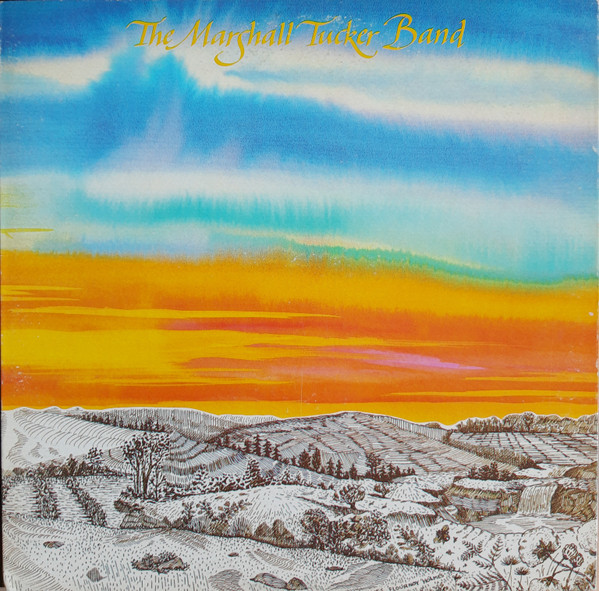
The Marshall Tucker Band
 View on Discogs
 View on Wikipedia
Album Summary
The Marshall Tucker Band's self-titled debut came roaring out of Spartanburg, South Carolina, recorded in late 1972 and released in 1973 on Capricorn Records — that beautiful Macon, Georgia label that was fast becoming the sacred ground of Southern rock. Produced by Paul Hornsby, who knew his way around the Allman Brothers circle and understood exactly what kind of fire these boys were carrying, the album captured something rare: a six-piece band that couldn't be boxed in by any one genre. Country, jazz, blues, and rock all lived together on this record without a single argument, held together by Toy Caldwell's deeply soulful lead guitar and Jerry Eubanks' flute and saxophone weaving through the mix like nothing else in Southern rock at the time. This was Capricorn releasing something genuinely untamed, and the world was about to find out.
Reception
- The debut was a slow-burning commercial triumph, building its momentum the old-fashioned way — through relentless touring and word of mouth — eventually finding its footing in the lower regions of the Billboard 200 rather than arriving with any overnight fanfare.
- Critics took notice of the album's sophisticated instrumental interplay and its genuine genre-blending ambition, acknowledging that The Marshall Tucker Band was offering a more jazz-inflected, musically adventurous vision of Southern rock than almost anyone else on the scene.
- 'Can't You See,' written by Toy Caldwell, emerged from this album as an immediate fan favorite and a song that would only grow in stature over the years, steadily cementing its place as one of the defining anthems of the entire Southern rock canon.
Significance
- This debut stands as a foundational document of the Southern rock movement, helping to solidify Capricorn Records as the undisputed home of the genre alongside labelmates the Allman Brothers Band — two pillars holding up the whole Southern rock cathedral.
- By placing flute and saxophone front and center as genuine lead voices rather than mere ornaments, the band carved out a sonic identity that pushed the stylistic boundaries of Southern rock into territory that felt genuinely original and endlessly soulful.
- The album introduced 'Can't You See' to the world, a Toy Caldwell composition that would transcend its moment and become one of the most beloved and long-lived songs in both Southern rock and country radio history, outlasting trends and generations alike.
Samples
- Can't You See — one of the most recognizable tracks in Southern rock, widely sampled and interpolated across country and hip-hop, most notably sampled by Notorious B.I.G. featuring Method Man and Lil' Kim in 'The World Is Filled...' (1997)
Tracklist
-
A1 Take The Highway 96
 6:10
6:10
-
A2 Can't You See 82
6:00
-
A3 Losing You 145
5:02
-
B1 Hillbilly Band 100
2:32
-
B2 See You Later, I'm Gone 81
3:01
-
B3 Ramblin' 117
5:01
-
B4 My Jesus Told Me So 87
5:28
-
B5 Ab's Song 87
1:12

Artist Details
The Marshall Tucker Band rose up out of Spartanburg, South Carolina in 1972, blending Southern rock with country, jazz, and blues in a way that felt like a long summer highway with the windows rolled down — nobody else was cooking up a sound quite like that. Led by vocalist Doug Gray and featuring the distinctly soulful flute and saxophone work of Jerry Eubanks, they carved out a lane all their own alongside Lynyrd Skynyrd and the Allman Brothers as pillars of the Southern rock movement, scoring big with classics like Can't You See and Heard It in a Love Song. Their significance goes beyond the charts — they helped define a regional pride and a rootsy American spirit that spoke to working folks from the Carolinas to California, leaving a legacy that still runs deep in country and rock to this day.