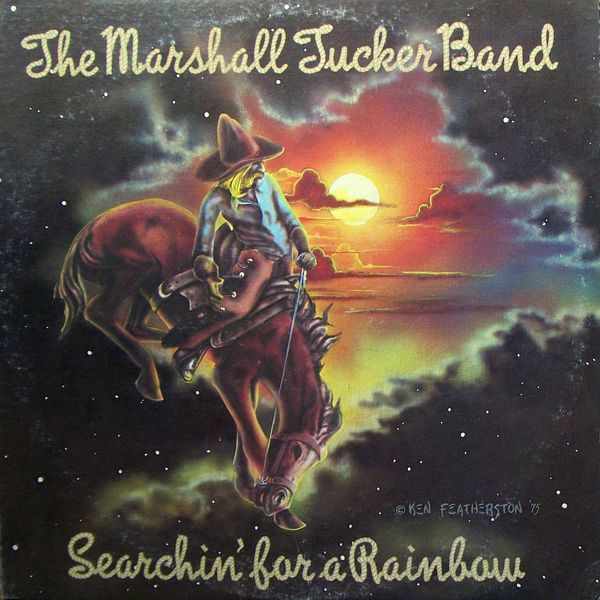
Searchin' For A Rainbow
 View on Discogs
Album Summary
Searchin' For A Rainbow was laid down at the legendary Capricorn Sound Studios in Macon, Georgia, and released in 1975 on Capricorn Records — the same hallowed ground that gave the world the Allman Brothers Band and became the beating heart of Southern rock during its golden era. Produced by Paul Hornsby, a man who understood the Marshall Tucker sound from the inside out, the album captured a band that had been forged and tempered by years of relentless touring, arriving in the studio with something to say and every ounce of soul needed to say it. Toy Caldwell's distinctive lead guitar work and Doug Gray's deeply felt vocals anchor a record that moves freely between country, jazz, blues, and rock — not as a stylistic exercise, but as a natural expression of who these men were as musicians. This was a band that had found its voice, and Searchin' For A Rainbow is the sound of that voice at full strength.
Reception
- Searchin' For A Rainbow performed strongly on the Billboard 200, reaching the top 15 and standing as one of the band's most commercially successful studio albums, proving that The Marshall Tucker Band had the staying power to match their considerable artistic ambitions.
- Critics responded warmly to the album's eclectic yet cohesive range, praising the band's rare ability to weave country and jazz sensibilities into a Southern rock framework that felt organic rather than calculated.
- The album further cemented the band's reputation as a live-hardened act whose studio recordings carried that same authentic, room-filling energy that made their concerts the stuff of legend among devoted fans.
Significance
- Searchin' For A Rainbow stands as one of the defining documents of mid-1970s Southern rock, with Jerry Eubanks' flute and saxophone work expanding the genre's sonic vocabulary far beyond what most listeners expected from a band flying that regional flag.
- The album contributed meaningfully to Capricorn Records' cultural dominance during Southern rock's commercial peak, adding another chapter to a label story that was reshaping American roots music from a small city in Georgia.
- With its natural bridge between rock and country sensibilities, Searchin' For A Rainbow foreshadowed the country-rock crossover that would sweep mainstream American music in the late 1970s and beyond, marking The Marshall Tucker Band as genuine architects of that movement.
Samples
- Can't You See — one of the most enduring songs in the Southern rock catalog, this Toy Caldwell classic has been sampled and interpolated across multiple genres, with its unmistakable chord progression and vocal melody appearing in numerous hip-hop and country recordings over the decades.
Tracklist
-
A1 Fire On The Mountain 101
 3:53
3:53
-
A2 Searchin' For A Rainbow 93
3:48
-
A3 Walkin' And Talkin' 110
2:25
-
A4 Virginia 166
4:54
-
B1 Bob Away My Blues 112
2:42
-
B2 Keeps Me From All Wrong 74
4:13
-
B3 Bound And Determined 129
4:20
-
B4 Can't You See 82
6:25

Artist Details
The Marshall Tucker Band rose up out of Spartanburg, South Carolina in 1972, blending Southern rock with country, jazz, and blues in a way that felt like a long summer highway with the windows rolled down — nobody else was cooking up a sound quite like that. Led by vocalist Doug Gray and featuring the distinctly soulful flute and saxophone work of Jerry Eubanks, they carved out a lane all their own alongside Lynyrd Skynyrd and the Allman Brothers as pillars of the Southern rock movement, scoring big with classics like Can't You See and Heard It in a Love Song. Their significance goes beyond the charts — they helped define a regional pride and a rootsy American spirit that spoke to working folks from the Carolinas to California, leaving a legacy that still runs deep in country and rock to this day.