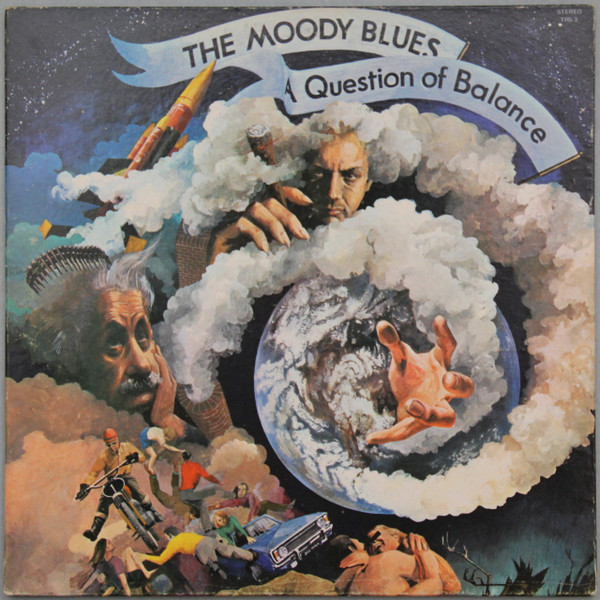
A Question Of Balance
 View on Discogs
Album Summary
A Question of Balance came to life in 1970, born out of a band at the height of their powers and their confidence. The Moody Blues laid it down on their own Threshold Records label — a label they built themselves, which tells you everything about where their heads were at. Co-produced by the band alongside the trusted Tony Clarke, who had been riding shotgun with these cats through their most creatively fertile years, the album arrived with a sense of purpose that went beyond just making music. This was a band asking real questions — about humanity, about balance, about what kind of world we were living in — and they were doing it with the full weight of their orchestral rock sound behind them. Recorded during a pivotal moment in the early progressive rock era, A Question of Balance carried forward the grand tradition the Moody Blues had been building since the late sixties, but with a leaner, more direct energy that felt both timely and timeless.
Reception
- The album soared to number 2 on the UK Albums Chart, a testament to just how deeply the British public had embraced this band's singular vision.
- Across the Atlantic, A Question of Balance broke into the top 10 on the US Billboard 200, confirming that the Moody Blues had built one of the most devoted audiences in rock music on both sides of the ocean.
- Critics of the day received the record warmly as a mature and confident continuation of the band's orchestral rock identity, even as some noted that its sonic approach felt more refined than radically experimental compared to their earlier conceptual landmarks.
Significance
- A Question of Balance stands as a defining document of the progressive rock and baroque pop fusion that the Moody Blues helped pioneer — proof that rock music could carry genuine philosophical weight without losing its soul.
- The album deepened the band's commitment to weaving classical orchestration into the fabric of rock and pop, with tracks like Melancholy Man and The Balance demonstrating a compositional ambition that few of their contemporaries could match.
- By reaching mass commercial audiences while refusing to simplify their artistic vision, A Question of Balance helped prove to the music industry that sophistication and accessibility were not mutually exclusive — a lesson that would echo through the symphonic rock movement for years to come.
Tracklist
-
A1 Question 134
 5:40
5:40
-
A2 How Is It (We Are Here) 107
2:48
-
A3 And The Tide Rushes In 99
2:57
-
A4 Don't You Feel Small 151
2:40
-
A5 Tortoise And The Hare 150
3:23
-
B1 It's Up To You 122
3:11
-
B2 Minstrel's Song 91
4:27
-
B3 Dawning Is The Day 94
4:22
-
B4 Melancholy Man 132
5:49
-
B5 The Balance 107
3:33

Artist Details
The Moody Blues were a magnificent British rock outfit that came together in Birmingham, England back in 1964, weaving together psychedelic rock, classical orchestration, and philosophical lyricism into a sound so lush and cosmic it practically invented the art rock and progressive rock genres before anyone even had a name for them. Their landmark 1967 album Days of Future Passed, recorded with the London Festival Orchestra, was a groundbreaking fusion of rock and classical music that shook the industry to its core and proved once and for all that rock and roll could be a serious, soul-stirring art form. These cats left an undeniable mark on music history, influencing generations of artists and earning a well-deserved induction into the Rock and Roll Hall of Fame in 2018, their dreamy, transcendent sound forever a reminder that music at its finest can lift the spirit straight to the stars.