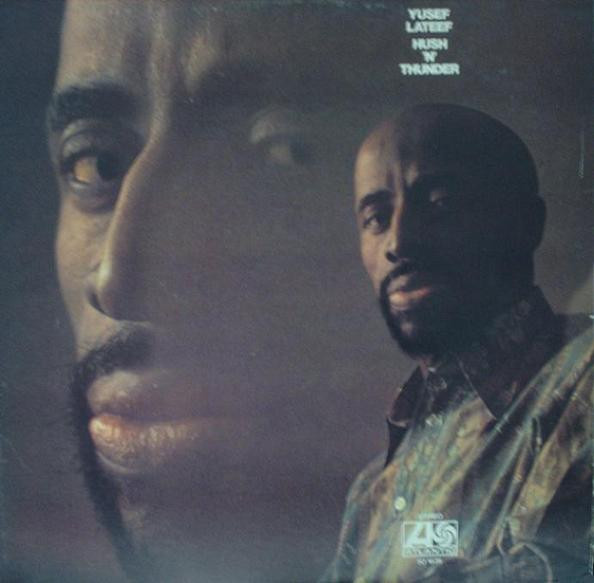
Hush 'N' Thunder
 View on Discogs
 View on Wikipedia
Album Summary
Hush 'N' Thunder landed on Atlantic Records in 1973, and baby, it arrived at just the right moment. Yusef Lateef — that restless, searching soul of a musician — was deep in his exploratory phase, pushing well past the hard bop foundations that first made his name. Recorded in the early seventies at a time when jazz was stretching its arms wide and pulling in funk, soul, and world music influences, this album finds Lateef in full command of his ever-expanding sonic universe. Atlantic, riding high as one of the premier homes for both soul and jazz, gave Lateef the space to let his vision breathe, and breathe it did — from the sacred to the soulful, from the meditative to the deeply funky.
Reception
- The album was received within jazz circles as a thoughtful and characteristically adventurous entry in Lateef's catalog, appreciated by listeners attuned to his ongoing fusion of spiritual depth and contemporary groove.
- Critics recognized the album as reflective of the broader early-1970s movement in which established jazz voices were embracing funk and soul textures without abandoning their artistic integrity.
- Hush 'N' Thunder did not chart prominently in mainstream markets, but held steady respect among jazz enthusiasts and collectors who understood the weight of what Lateef was putting down.
Significance
- Hush 'N' Thunder stands as a proud artifact of the early-1970s jazz-funk convergence, demonstrating how a master like Lateef could honor the sacred and the secular in the same breath — drawing from gospel touchstones like 'Come Sunday' and 'His Eye Is On The Sparrow' while riding contemporary rhythmic currents.
- The album is a showcase for Lateef's unmatched multi-instrumental artistry, weaving together his signature oboe and flute alongside conventional jazz ensemble voices in a way that no other bandleader of the era could quite replicate.
- Spirituality runs like a deep river through this record — from 'Prayer' to 'Destination Paradise' — placing Hush 'N' Thunder firmly in the tradition of jazz as a music of the human soul, not just the concert hall.
Tracklist
-
A1 Come Sunday 157
 2:33
2:33
-
A2 The Hump 95
4:39
-
A3 Opus Pt. I / Opus Pt. II —
8:08
-
A4 This Old Building 74
2:42
-
B1 Prayer 96
3:19
-
B2 Sunset 125
7:53
-
B3 His Eye Is On The Sparrow 184
5:32
-
B4 Destination Paradise 69
3:54

Artist Details
Yusef Lateef was a visionary Detroit-born multi-instrumentalist and composer who came up through the bebop scene of the late 1940s before transcending every label anyone tried to put on him, blending jazz with the sounds of Africa, the Middle East, and Asia in a way that made listeners feel like they were hearing music from the very soul of the universe. His 1957 classic Prayer to the East and landmark albums like Eastern Sounds put him at the forefront of what folks were calling world music long before the rest of the world caught up, and his use of instruments like the oboe, bamboo flute, and shanai gave jazz a spiritual depth that was absolutely unmatched. Lateef, who later earned a doctorate in music and converted to Islam, proved that jazz was not just American music but a living, breathing conversation with all of humanity, and his influence can be heard in everyone from John Coltrane to the most adventurous musicians working today.