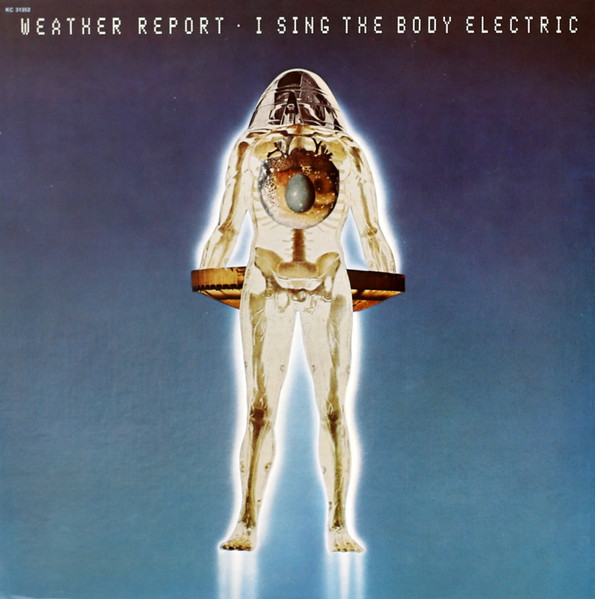
I Sing The Body Electric
 View on Discogs
Album Summary
Recorded partly in the studio and partly live in Tokyo, Japan, 'I Sing The Body Electric' arrived in 1972 on Columbia Records, produced by the band themselves under the watchful creative eye of co-founders Wayne Shorter and Joe Zawinul. The album is a hybrid creature — one side born in the controlled electricity of the studio, the other captured in the fire of a live performance before a Japanese audience who received these cosmic explorers like visiting royalty. It was Weather Report's second studio offering, and it announced to the world that this band was not going to sit still for anybody.
Reception
- Critics at the time were divided, some finding the album's free-floating structures challenging, while forward-thinking jazz voices recognized it as a bold and necessary step beyond the conventions of the day.
- The album did not make significant commercial chart inroads, but it built Weather Report's reputation among serious listeners and musicians as one of the most adventurous ensembles on the planet.
- Over the decades, critical reassessment has been deeply kind — the album is now widely regarded as an essential document of early jazz fusion at its most fearless and exploratory.
Significance
- The album stands as one of the earliest and most compelling arguments that jazz could absorb electronic textures, world music influences, and avant-garde freedom without losing its soulful center.
- By weaving together studio compositions and live performance on a single record, Weather Report created a template for how jazz artists could present multiple dimensions of their creative identity within one cohesive statement.
- The band's internationalism — recording live in Japan and drawing on musical colors from across the globe — pointed toward a worldly, borderless conception of jazz that would influence generations of musicians who came after.
Samples
- Directions — sampled and interpolated by various hip-hop and electronic producers drawn to its hypnotic rhythmic energy and atmospheric density, cementing its reputation as one of the album's most enduring sonic statements.
Tracklist
-
A1 Unknown Soldier 141
 7:57
7:57
-
A2 The Moors 92
4:49
-
A3 Crystal 72
7:23
-
A4 Second Sunday In August 148
4:04
-
B2 Surucucú —
7:46
-
B3 Directions 78
4:37

Artist Details
Weather Report was a jazz fusion powerhouse born out of New York City in 1970, brought to life by the brilliant minds of keyboardist Joe Zawinul and saxophonist Wayne Shorter, two cats who had already paid their dues with Miles Davis before striking out to create something entirely their own. Their sound was a cosmic blend of jazz, funk, rock, and world music — electric, unpredictable, and deeply soulful — reaching its peak groove with the landmark 1977 album Heavy Weather, which gave the world the irresistible bass line of Birdland, played by the incomparable Jaco Pastorius. Weather Report didn't just push the boundaries of jazz — they shattered them, proving that improvisation and innovation could live together on the same stage, and their influence echoes through every genre-bending musician who came after them.