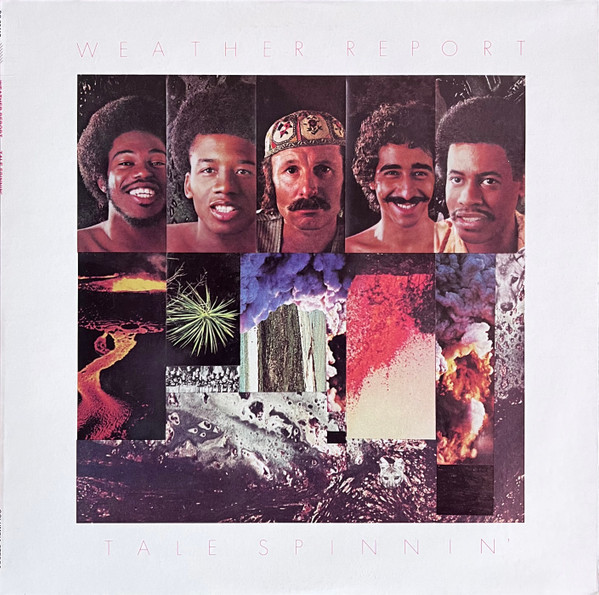
Tale Spinnin'
 View on Discogs
 View on Wikipedia
Album Summary
Tale Spinnin' came to life in 1975 on Columbia Records, and baby, it arrived like a warm front rolling through the jazz world — inevitable, powerful, and impossible to ignore. This was Weather Report doing what Weather Report did best: pushing the boundaries of what a band could be, what a record could feel like, what music could mean. Produced by the band themselves, with the visionary Joe Zawinul steering the ship from behind his keyboards and the young, already-electric Jaco Pastorius laying down a bass foundation that made grown musicians weep, Tale Spinnin' stood as a bold statement of artistic self-determination. No outside hands shaping the clay — just the band, their instruments, and a collective genius that the mid-seventies were blessed to witness in real time.
Reception
- Tale Spinnin' climbed to #31 on the Billboard 200, proving that Weather Report's brand of sophisticated jazz fusion had found a genuine audience beyond the critics and the conservatory crowd.
- The album drew widespread critical acclaim for the compositional depth and technical ambition it brought to the fusion genre, with reviewers recognizing it as a mature and fearless body of work.
- Jaco Pastorius's fretless bass work throughout the record was singled out by critics as something genuinely revelatory — a new voice on the instrument that changed what was considered possible.
Significance
- Tale Spinnin' stands as one of the defining documents of mid-1970s jazz fusion, weaving together complex polyrhythms, lush electronic textures, and compositional ambition into something that felt both cerebral and deeply soulful.
- The album cemented Jaco Pastorius's emergence as one of the most transformative bass voices in modern music, his fretless technique casting a long shadow over fusion, R&B, and contemporary music for decades to come.
- By producing the record themselves and refusing to compromise their artistic vision for commercial convention, Weather Report established a template for creative autonomy that influenced generations of jazz and fusion artists who followed.
Samples
- Freezing Fire — one of the most recognized tracks from this album in sampling culture, drawn upon by producers for its driving rhythmic energy and dense percussive interplay
Tracklist
-
A1 Man In The Green Shirt —
 6:26
6:26
-
A2 Lusitanos —
7:17
-
A3 Between The Thighs 99
9:30
-
B1 Badia 137
5:17
-
B2 Freezing Fire 130
7:26
-
B3 Five Short Stories 138
6:54

Artist Details
Weather Report was a jazz fusion powerhouse born out of New York City in 1970, brought to life by the brilliant minds of keyboardist Joe Zawinul and saxophonist Wayne Shorter, two cats who had already paid their dues with Miles Davis before striking out to create something entirely their own. Their sound was a cosmic blend of jazz, funk, rock, and world music — electric, unpredictable, and deeply soulful — reaching its peak groove with the landmark 1977 album Heavy Weather, which gave the world the irresistible bass line of Birdland, played by the incomparable Jaco Pastorius. Weather Report didn't just push the boundaries of jazz — they shattered them, proving that improvisation and innovation could live together on the same stage, and their influence echoes through every genre-bending musician who came after them.