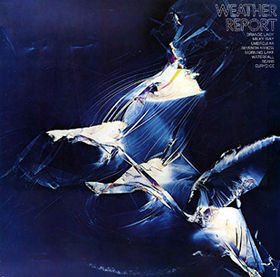
Weather Report
 View on Discogs
 View on Wikipedia
Album Summary
Weather Report's self-titled debut dropped in 1971 on Columbia Records, arriving like a quiet storm that nobody quite saw coming. Born out of the creative restlessness of keyboardist Joe Zawinul and saxophonist Wayne Shorter — both fresh from their transformative work with Miles Davis — the album was recorded with a cast of percussionists and rhythm explorers that included the Brazilian fire of Airto Moreira and Dom Um Romao, the elastic bass of Miroslav Vitous, and the drumming of Alphonse Mouzon. Columbia gave these cats the room to breathe, and what they produced was something that didn't fit neatly into any box the record industry had ready for it.
Reception
- Critics who caught up with it recognized the album as a bold opening statement from a band that was clearly playing a long game, though its abstract textures made it a slower burn with mainstream audiences.
- The jazz press took notice of the band's willingness to dissolve conventional song structure in favor of pure atmosphere and collective improvisation, setting it apart from the more groove-oriented fusion emerging at the same time.
- It did not generate significant commercial chart activity, but it established Weather Report as a serious artistic force in the early fusion conversation.
Significance
- The album stands as one of the founding documents of jazz fusion's more impressionistic wing, proving that the genre didn't have to be loud and electric to be revolutionary — it could be spacious, mysterious, and deeply textured.
- Tracks like 'Orange Lady' and 'Morning Lake' demonstrated that Weather Report was less interested in blowing over chord changes and more committed to building sonic environments, a philosophy that would define the band's entire career.
- The sheer density of percussive talent on the record — drawing on Afro-Brazilian and African rhythmic traditions alongside jazz and European avant-garde influences — pointed toward a global musical vocabulary that fusion would continue to explore throughout the decade.
Tracklist
-
A1 Milky Way 117
 2:30
2:30
-
A2 Umbrellas 121
3:24
-
A3 Seventh Arrow 138
5:20
-
A4 Orange Lady 121
8:40
-
B1 Morning Lake 134
4:23
-
B2 Waterfall 99
6:18
-
B3 Tears 127
3:22
-
B4 Eurydice 106
5:43

Artist Details
Weather Report was a jazz fusion powerhouse born out of New York City in 1970, brought to life by the brilliant minds of keyboardist Joe Zawinul and saxophonist Wayne Shorter, two cats who had already paid their dues with Miles Davis before striking out to create something entirely their own. Their sound was a cosmic blend of jazz, funk, rock, and world music — electric, unpredictable, and deeply soulful — reaching its peak groove with the landmark 1977 album Heavy Weather, which gave the world the irresistible bass line of Birdland, played by the incomparable Jaco Pastorius. Weather Report didn't just push the boundaries of jazz — they shattered them, proving that improvisation and innovation could live together on the same stage, and their influence echoes through every genre-bending musician who came after them.