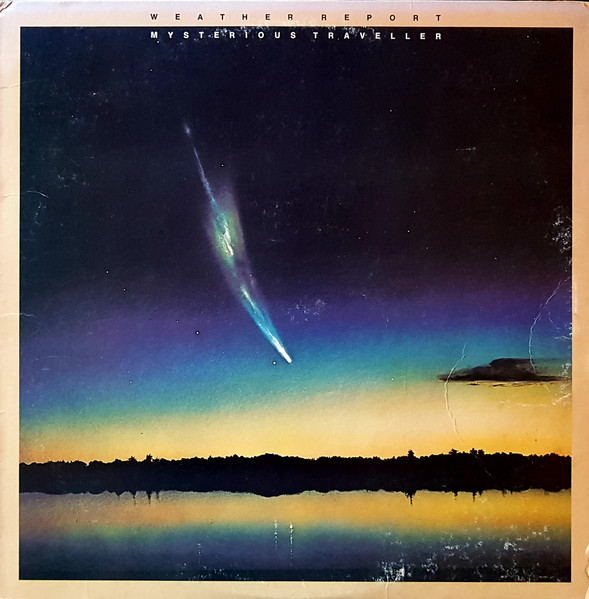
Mysterious Traveller
 View on Discogs
 View on Wikipedia
Album Summary
Mysterious Traveller was recorded and released in 1974 on Columbia Records, arriving at a moment when Weather Report — the visionary jazz-fusion collective co-led by keyboardist Joe Zawinul and saxophonist Wayne Shorter — was pushing deeper into uncharted sonic territory. Produced by Joe Zawinul and Wayne Shorter themselves, the album drew on a remarkable rotating cast of percussionists and bassists, including the then-emerging Jaco Pastorius, Alphonso Johnson, Miroslav Vitous, Airto Moreira, Dom Um Romao, Alphonse Mouzon, Narada Michael Walden, and Leon Ndugu Chancler. That rich, shifting personnel gave the record a restless, exploratory energy that felt unlike anything else on the shelves in 1974 — a genuine document of musicians refusing to stand still.
Reception
- Critics embraced Mysterious Traveller as a bold and adventurous step forward for the band, with many noting that Zawinul and Shorter had deepened their command of texture, rhythm, and space in ways that set the album apart from their earlier work.
- The album reinforced Weather Report's reputation as one of the most intellectually serious and musically daring groups in the fusion movement, earning respect from both jazz purists and rock-influenced listeners.
- Though not a mainstream chart phenomenon, Mysterious Traveller performed solidly within the jazz market and helped cement the band's commercial relationship with Columbia Records through the mid-1970s.
Significance
- Mysterious Traveller stands as a cornerstone of the jazz-fusion genre, demonstrating how African rhythmic traditions, electronic textures, and post-bop improvisation could be woven together into something genuinely new and alive.
- The album's use of a fluid, ensemble-oriented approach — with no fixed rhythm section and multiple percussionists contributing across sessions — influenced how later fusion and avant-garde jazz groups thought about collective composition and spontaneous arrangement.
- Tracks like 'Cucumber Slumber' and 'Scarlet Woman' showcased a melodic sophistication and tonal daring that would prove deeply influential on the generation of jazz musicians and producers who came up in the late 1970s and 1980s.
Samples
- "Cucumber Slumber" — one of the most recognizable tracks from this album in hip-hop sampling culture, its groove has been drawn upon by producers across multiple eras of sample-based music.
- "Scarlet Woman" — sampled and interpolated across soul, hip-hop, and neo-soul productions, the track's lush melodic line gave it a long afterlife in sample-heavy genres.
Tracklist
-
A1 Nubian Sundance —
 10:40
10:40
-
A2 American Tango —
3:42
-
A3 Cucumber Slumber —
8:22
-
B1 Mysterious Traveller —
7:18
-
B2 Blackthorn Rose —
5:02
-
B3 Scarlet Woman —
5:47
-
B4 Jungle Book —
7:20

Artist Details
Weather Report was a jazz fusion powerhouse born out of New York City in 1970, brought to life by the brilliant minds of keyboardist Joe Zawinul and saxophonist Wayne Shorter, two cats who had already paid their dues with Miles Davis before striking out to create something entirely their own. Their sound was a cosmic blend of jazz, funk, rock, and world music — electric, unpredictable, and deeply soulful — reaching its peak groove with the landmark 1977 album Heavy Weather, which gave the world the irresistible bass line of Birdland, played by the incomparable Jaco Pastorius. Weather Report didn't just push the boundaries of jazz — they shattered them, proving that improvisation and innovation could live together on the same stage, and their influence echoes through every genre-bending musician who came after them.